Introduction
With a high-precision laser cutting machine, you can process more than just standard metals and ceramics. Metal-ceramic composites open new opportunities for precision manufacturing. This guide covers the types of composites suitable for laser cutting, their applications, and key precautions to optimize production.
Key Takeaways
Most laminated, infiltrated, skeleton-reinforced, and gradient composites can be laser cut.
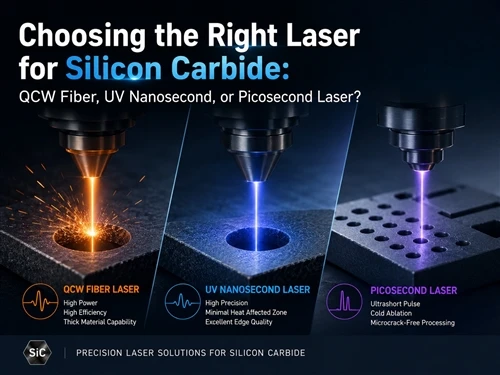
High-power fiber lasers are recommended for thick plates, while UV or picosecond lasers are best for thin sheets and micro parts.
Materials with large thermal expansion differences, high porosity, or extreme brittleness require careful parameter control to avoid cracking or chipping.
1. Laminated Composites
The most common and easiest to cut, formed by stacking or bonding ceramic sheets with metal layers.
Examples:
Al₂O₃ + Cu / Stainless Steel → Vacuum substrates, electronic housings
Si₃N₄ + Cu / Ti → IGBT and AMB substrates
AlN + Cu → High-thermal-conductivity electronic substrates
ZrO₂ + Ti / Ni → Sensors and medical components
SiO₂ + Ti / Steel → Aerospace sealing components
2. Infiltrated or Sintered Composites
Metal infiltrates a ceramic skeleton, creating a stable structure suitable for laser cutting.
Examples:
SiC + Al / Mg → Aerospace heat sinks
Al₂O₃ + Cu / Ag → High-thermal-conductivity electrodes
WC + Co / Ni → Cemented carbides
3. Particle-Reinforced Metal Matrix Composites
Ceramic particles embedded in a metal matrix, generally smooth to cut. The metal absorbs the laser, while the particles melt or vaporize, minimizing chipping.
Examples:
Al + SiC → Aerospace electronic heat sinks
Mg + SiC / Al₂O₃ → Structural components
Cu + Al₂O₃ / ZrO₂ → High-strength conductive electrodes
4. Functionally Graded Composites
Gradual thermal expansion reduces stress concentration, making laser cutting safer and crack-free, often used for high-temperature aerospace components.
Examples:
Al₂O₃ → Kovar
SiC → Ti
ZrO₂ → Stainless Steel
5. Metallized Ceramics
Mo-Mn metallized ceramics and Ag-Cu-Ti active-braze assemblies can be laser cut for outlines, holes, and slots. Avoid overheating the braze seam.
Examples:
Mo-Mn metallized Al₂O₃ → Brazed ceramic components
Ag-Cu-Ti active-braze assemblies
Not Recommended or Use Caution
High-porosity foam ceramics + metal → prone to burning, chipping, deformation
Very thick dissimilar layers without gradients → thermal mismatch, cracking risk
Composites containing low-melting-point glass → bubbling, delamination