Zirconia (ZrO₂) is widely used in advanced manufacturing because of its high strength, toughness, heat resistance, corrosion resistance, and electrical insulation properties. Typical applications include precision ceramic components, consumer electronics, semiconductor-related parts, medical components, and industrial structural ceramics.
However, zirconia is also challenging to process. Its hardness and brittleness can make conventional machining difficult, particularly for thin parts, complex contours, fine features, and precision holes. Depending on the application, mechanical processing may lead to tool wear, edge chipping, or cracking.
Laser processing provides a non-contact alternative for zirconia cutting, drilling, scribing, and grooving. However, there is no single laser configuration that is suitable for every zirconia application.


The right machine depends mainly on:
Material thickness
Part size
Required precision
Feature and hole size
Edge-quality requirements
Production volume and throughput
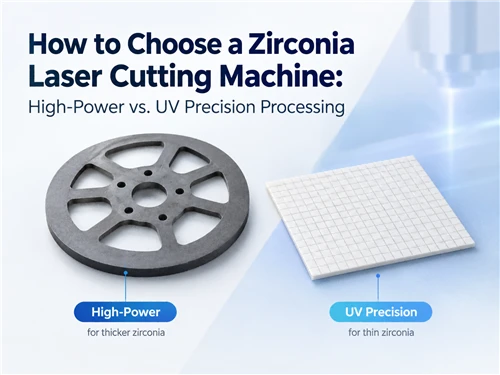
This article compares two typical approaches for zirconia laser processing: high-power laser systems for thicker and higher-throughput applications and UV nanosecond laser systems for thin and precision processing.
1. Why Is Zirconia Difficult to Process?
The material properties of zirconia directly affect the selection of a processing method and laser system.
High Hardness and Brittleness
Zirconia combines relatively high hardness with ceramic brittleness. Complex mechanical cutting or drilling may increase the risk of edge chipping or cracking, especially when processing small features or thin sections.
Wide Range of Thicknesses
Zirconia components can range from thin ceramic sheets and precision parts to thicker industrial structural components. Different thicknesses require different energy levels, processing strategies, and motion systems.
High Requirements for Edge Quality
Some applications require precise contours, small holes, smooth cut surfaces, and controlled thermal effects. The required processing quality can vary significantly between industrial structural parts and precision electronic or micro-scale components.
Different Production Requirements
Some manufacturers need rapid prototyping and small-batch production, while others require larger working areas and continuous industrial production. These requirements directly influence the choice of laser power, machine structure, automation, and processing speed.
For this reason, zirconia laser cutting systems should be selected according to the actual application rather than laser power alone.
2. Four Key Factors When Selecting a Zirconia Laser Cutting Machine
Before choosing a machine, manufacturers should first evaluate four key factors.
2.1 Material Thickness
Material thickness is one of the most important factors.
Thin zirconia components often require better control of thermal effects and finer processing capabilities. Thicker zirconia parts generally require higher energy input and a processing system capable of maintaining stable cutting performance.
However, thickness alone should not determine the machine configuration. Material density, color, composition, geometry, and required cut quality can also affect the final process.
2.2 Required Precision
Applications involving micro holes, fine contours, narrow slots, and small precision parts generally require a different laser configuration from standard industrial cutting applications.
UV nanosecond laser systems are commonly considered when the application requires:
Fine features
Small holes
Precision contours
Thin zirconia parts
Reduced thermal influence
High-power systems are generally more suitable when production capacity and material penetration are higher priorities.
2.3 Part Size
The working area of the machine should match the size of the workpiece and production method.
Large zirconia sheets or multiple-part layouts may benefit from a larger working area, while small precision components can often be processed more efficiently on a compact precision platform.
2.4 Production Volume
The production requirement also affects equipment selection.
For example:
R&D and prototyping may prioritize flexibility and precision.
Small-batch custom production may require fast programming and easy setup.
Industrial batch production may prioritize stability, throughput, and larger processing capacity.
The best machine is therefore not necessarily the most powerful system, but the one that matches the actual production requirements.
3. High-Power Laser Processing for Zirconia
High-power zirconia laser processing systems are designed primarily for applications involving thicker materials, larger processing areas, and higher production requirements.
A typical example is the YCTC Series Ceramic Laser Cutting and Drilling Machine.
Typical Applications
High-power laser systems may be considered for:
Medium and thicker zirconia components
Larger ceramic parts
Batch production
Cutting and profiling
Drilling larger or deeper features
Grooving and scribing
Industrial ceramic structural components
Depending on the material and process requirements, thicker zirconia parts generally require higher laser energy and optimized process parameters.
Typical Machine Configuration
The YCTC series can be configured with features such as:
High-power fiber laser sources
Rigid enclosed machine structure
Precision granite platform
High-precision motion system
Closed-loop motion control
High-resolution position feedback
Customized processing software
For specific zirconia applications, the machine can also be configured according to the required processing area, laser power, and production requirements.
A typical configuration may include:
Laser power: up to 1000 W, depending on the application
Maximum working area: up to 600 × 600 mm
X/Y repeat positioning accuracy: up to ±5 μm, depending on machine configuration
Maximum axis speed: up to 60 m/min
Actual cutting performance depends on zirconia thickness, material properties, geometry, laser configuration, and required processing quality.
Main Advantages
For suitable zirconia applications, a high-power laser system can provide advantages in:
Higher Processing Capacity
Higher laser energy can support the processing of thicker zirconia components and applications requiring greater material removal.
Larger Working Area
A larger processing platform can support larger parts or multiple components in a single layout.
Industrial Production Capability
High-power systems are more suitable for applications where production capacity and continuous processing are important considerations.
Flexible Processing
The system can be used for multiple operations, including:
Cutting
Drilling
Grooving
Scribing
Complex contour processing
This makes high-power systems suitable for many industrial ceramic applications.
4. UV Nanosecond Laser Processing for Thin Zirconia
UV nanosecond laser systems are designed for applications requiring finer processing and better control of small features.
They are particularly suitable for thin zirconia components, precision contours, micro holes, and small-scale ceramic parts.
Typical Applications
UV precision laser systems may be considered for:
Thin zirconia sheets
Small precision components
Fine contours
Micro holes
Narrow slots
Complex geometries
R&D and prototyping
Small-batch custom production
Based on typical zirconia applications, UV nanosecond processing is particularly suitable for thin zirconia materials, such as approximately 0.1–0.8 mm, depending on material properties and processing requirements.
Other thickness ranges should be evaluated through sample testing.
Precision Processing Features
A UV nanosecond laser system can be configured with:
355 nm UV laser source
Precision motion system
CCD vision positioning
Automatic alignment and correction
DXF file import
Multi-layer processing
Fine trajectory control
These features are particularly useful when processing small or irregularly shaped zirconia components.
Main Advantages
Fine Feature Processing
UV laser systems are suitable for applications involving small contours, precision slots, and fine structures.
Reduced Thermal Influence
Compared with higher-energy thermal processing approaches, UV laser processing can help reduce thermal influence on thin zirconia materials when parameters are properly optimized.
Flexible Production
Complex geometries can be programmed directly from digital drawings without dedicated mechanical tooling, making the system suitable for prototyping and custom production.
Small-Part Processing
CCD positioning and precision motion control can improve alignment and positioning when processing small or irregular zirconia components.
5. High-Power vs. UV Precision Laser Systems
|
Comparison |
||
|
Primary Application |
Thicker parts and higher-throughput production |
Thin parts and precision processing |
|
Typical Material Range |
Medium to thicker zirconia components* |
Thin zirconia components, typically around 0.1–0.8 mm* |
|
Processing Area |
Larger working areas available |
Compact precision working area |
|
Main Priority |
Processing capacity and throughput |
Precision and fine-feature processing |
|
Typical Features |
Cutting, drilling, grooving, and larger contours |
Micro holes, fine contours, narrow slots, and small parts |
|
Production Type |
Batch and industrial production |
R&D, prototyping, and precision production |
|
Key Selection Factor |
Material thickness, part size, and production volume |
Feature size, precision, and edge-quality requirements |
*Actual processing capability depends on material composition, thickness, geometry, laser configuration, and required processing quality.
6. Which Zirconia Laser System Should You Choose?
Consider a High-Power Laser System If You Need:
Processing of medium or thicker zirconia components
Larger working areas
Higher production capacity
Batch production
Larger contours or industrial structural components
Higher material processing capability
A high-power system is generally the more suitable choice when throughput and processing capacity are the main priorities.
Consider a UV Precision Laser System If You Need:
Thin zirconia processing
Fine contours
Small precision components
Micro holes
Narrow slots
Complex geometries
R&D and prototyping
Small-batch custom production
A UV precision system is generally more suitable when feature size and processing precision are more important than maximum production capacity.
Sample Testing Is Recommended When:
The application falls into an overlapping range between different laser technologies, such as:
Special zirconia grades
Unusual material colors
Strict edge-quality requirements
Complex geometries
Tight dimensional tolerances
Thicknesses close to the boundary between different processing approaches
In these cases, equipment selection should be based on actual processing tests rather than theoretical parameters alone.
7. Common Mistakes When Choosing a Zirconia Laser Cutting Machine
Mistake 1: Choosing the Highest Power Without Considering the Application
Higher power is not always better.
For thin or precision zirconia components, excessive energy may increase thermal effects or make process control more difficult. A precision UV laser system may be a better match for small features and thin materials.
Mistake 2: Selecting a Precision System for High-Throughput Thick-Material Production
A compact precision laser system may not be the most efficient solution for thicker zirconia parts or large-volume production.
For these applications, a higher-power laser source and industrial machine platform may provide better processing capacity.
Mistake 3: Selecting Equipment Based on Thickness Alone
Material thickness is important, but it is not the only factor.
The final selection should also consider:
Material grade
Density
Color
Part geometry
Hole size
Required precision
Edge quality
Production volume
Mistake 4: Using a General-Purpose System Without Process Optimization
Ceramic materials have different processing characteristics from metals and many other materials.
A laser system designed or optimized for ceramic processing can provide advantages in laser parameters, motion control, process development, and application matching.
8. Why Sample Testing Is Important
For zirconia laser processing, sample testing is one of the most reliable ways to select the right equipment configuration.
Before finalizing a machine, it is recommended to provide:
Material type
Material thickness
Part dimensions
CAD drawing
Hole or feature size
Required tolerance
Required edge quality
Estimated production volume
Sample testing can help determine the appropriate:
Laser type
Laser power
Processing parameters
Working area
Motion configuration
Production solution
This is particularly important for new materials, complex geometries, and high-precision applications.
9. Zirconia Laser Processing Solutions from YCLaser
YCLaser focuses on laser processing solutions for advanced ceramic materials.
For zirconia applications, equipment configurations can be selected according to different processing requirements, including:
High-power ceramic laser processing systems
UV precision laser cutting systems
Customized working areas
Cutting and drilling applications
Precision contour processing
Sample testing and process evaluation
In addition to zirconia, the equipment can also be configured for selected advanced ceramic materials and related applications.
YCLaser provides support for:
Application evaluation
Sample testing
Equipment customization
Process development
Technical training
After-sales technical support
Conclusion
There is no single "best" zirconia laser cutting machine for every application.
The right solution depends on the relationship between material thickness, feature size, required precision, part dimensions, and production volume.
In general:
High-power laser systems are more suitable for thicker zirconia components, larger processing areas, and higher-throughput industrial applications.
UV nanosecond laser systems are better suited to thin zirconia materials, fine features, micro holes, precision contours, and small-scale processing.
For applications with special materials or demanding quality requirements, sample testing is recommended before equipment selection.
If you are evaluating a zirconia laser cutting solution, YCLaser can provide application analysis and sample testing based on your material and processing requirements.Contact us now!