Zirconia (ZrO₂) is one of the most process-sensitive engineering ceramics. It offers excellent hardness, fracture toughness, and biocompatibility. However, when cut with an unsuitable laser or poorly chosen parameters, the cut edge may darken, turn black, or develop micro-cracks that can weaken the component.
This guide discusses why zirconia is prone to burning and how three laser technologies-QCW fiber, UV, and picosecond-can help avoid these issues. The information is drawn from publicly available technical literature and manufacturer documentation.
Why Zirconia Burns During Laser Cutting (Root Causes)?
Before selecting a laser, it is helpful to understand what "burn" really means on zirconia. It is not simple oxidation like on metals; it typically involves a combination of three effects:
Heat accumulation – Zirconia has low thermal conductivity, so absorbed laser energy tends to build up in a shallow surface layer. This creates a heat-affected zone (HAZ). With conventional nanosecond lasers, the HAZ may be relatively wide, while shorter pulse durations (picosecond or femtosecond) can reduce it significantly.
Oxygen loss and discoloration – During high-temperature ablation followed by rapid cooling, the surface can lose oxygen and become darker. This visible black/dark edge is associated with a change in the surface chemistry (reduction of zirconium ions). The discoloration is often reversible; re-heating the part in an oxygen-containing atmosphere can restore the white colour.
Phase transformation – Excess heat can cause the zirconia to transform from the tetragonal to the monoclinic phase near the cut edge. This transformation may reduce local fracture toughness and increase the risk of chipping or cracking. The severity depends on the thermal exposure during processing.
In practice, achieving a burn-free cut is largely a matter of controlling the HAZ. Shorter thermal interaction tends to produce whiter, stronger edges.
Three Laser Approaches for Burn-Free Zirconia Cutting
1. QCW Fiber Laser (1060–1080 nm) – Speed and Thickness
Quasi-continuous-wave (QCW) fiber lasers operate with nanosecond-scale pulses but modulate the output so that the material cools between pulse bursts. This intermittent heating reduces thermal accumulation compared with continuous-wave lasers, while maintaining high material removal rates.
HAZ size: typically in the nanosecond class, often smaller when the duty cycle is carefully adjusted.
Strengths: high throughput, capable of cutting relatively thick sections.
Suitable for: structural zirconia parts from thin to several millimetres thick, high-volume production.
Cost: moderate (generally more expensive than standard nanosecond fiber lasers, but less than UV or picosecond systems).
Many machine builders offer QCW fiber sources for ceramic cutting, with good repeatability and thickness coverage. In one reported case, cutting a batch of thin zirconia parts with laser took considerably less time than conventional CNC machining.
Key point: QCW provides productivity; burn control depends on proper parameter tuning.
2. UV Laser (355 nm) – Photochemical "Cold Cutting"
UV lasers cut primarily by photochemical bond breaking rather than melting. The high photon energy directly breaks molecular bonds, so very little energy is converted to heat. This minimises thermal-stress cracking and carbonisation.
HAZ size: very small, approaching microscopic or even nanoscopic scale; carbonisation is virtually absent.
Strengths: exceptionally clean edges on thin and brittle materials.
Suitable for: thin zirconia (below about 0.3 mm), micro-holes, high-aspect-ratio microstructures; high yields are reported for thin substrates.
Cost: relatively high-typically several times that of a QCW system.
3. Picosecond Laser – Ultrafast Cold Ablation
Picosecond lasers deliver pulses that are orders of magnitude shorter than nanosecond pulses. The energy is deposited so quickly that it vaporises the material before heat can diffuse into the surrounding area.
HAZ size: near-zero, with a HAZ that is usually much smaller than that of nanosecond processing.
Strengths: best edge quality and minimal thermal damage; preferred for medical/dental and high-strength applications.
Suitable for: ultra-thin or precision parts where phase transformation is unacceptable.
Cost: high (often significantly more than QCW).
Quick Comparison Table
|
Dimension |
QCW Fiber (ns) |
UV 355 nm |
Picosecond |
|
Pulse width |
10⁻⁹ s |
ns–ps class |
10⁻¹² s (1000× shorter) |
|
Removal mechanism |
Controlled thermal |
Photochemical |
Cold ablation |
|
HAZ |
<50 μm class |
micro–nano |
Near-zero (<10 μm) |
|
Edge quality |
Good (needs tuning) |
Excellent |
Best |
|
Throughput |
High |
Medium |
Low–Medium |
|
Burn/blackening risk |
Medium |
Very low |
Lowest |
|
Relative machine cost |
Medium |
Med–High |
High (3–5× QCW) |
|
Typical thickness |
0.2–11 mm |
<0.3 mm |
Ultra-thin / precision |
Process Parameters That Help Avoid Burns
Even the best laser can cause burning if the parameters are not set correctly. The following guidelines are generally recommended:
Pulse overlap – Keep overlap within a moderate range (not too low, not too high). Too low overlap creates steps and heat spikes; too high builds up excessive heat. Increase repetition rate to raise speed instead.
Scan speed – For ceramic cutting, scan speeds in a moderate range (e.g., a few hundred mm/s) are often found to avoid both under-cutting and edge micro-cracking.
Co-axial assist gas – Using an inert gas (e.g., nitrogen) coaxial with the laser beam helps blow away molten debris, reduces plasma shielding, and provides active cooling-this is a simple way to minimise HAZ and discoloration.
Duty cycle tuning (QCW) – Because QCW removes heat between pulses, increasing the interval (lower duty cycle) at the same average power can shrink the HAZ on thicker zirconia.
Multi-pass, low-energy strategy – Several shallow passes with low single-pulse energy are often better than one deep, hot pass. This is common practice with UV and picosecond lasers.
Post-process annealing – If slight discoloration remains, a light anneal in an oxygen-containing atmosphere can restore the white colour, since the blackening is typically a reversible oxygen-deficiency effect. However, this will not reverse deep phase transformation, so preventing HAZ is the primary goal.
Choosing the Right Machine for Your Zirconia
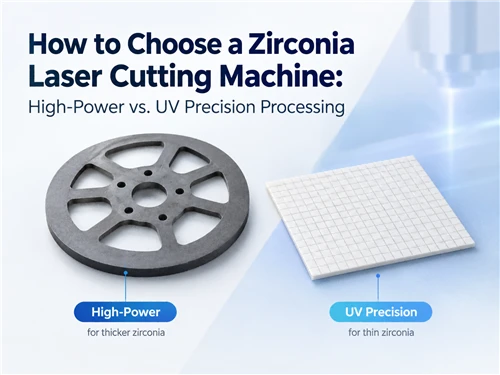
Thick parts and high volume → A QCW fiber cutting system is often the most productive choice.
Thin substrates, micro-holes, or cosmetic-critical edges → UV lasers are preferable.
Medical/dental parts where phase transformation must be avoided → Picosecond is generally the technically superior option.
FAQ
Q: Can zirconia be laser cut without turning black?
A: Yes. Blackening results from oxygen loss in the HAZ. Using short-pulse (UV or picosecond) or properly tuned QCW with gas assist can keep the edge white.
Q: UV or picosecond-which is better?
A: Both can produce burn-free results. UV is often more economical for thin substrates and micro-features; picosecond gives the lowest HAZ and is preferred for medical/dental and strength-critical components.
Q: Is a QCW fiber laser suitable for zirconia?
A: Yes, especially for thicker materials and higher throughput. It requires careful tuning of intervals, overlap, and assist gas to control the HAZ.
Q: How can blackening be removed after cutting?
A: A mild annealing/re-sintering step can restore the white colour by re-oxidising the surface. However, this does not repair any deep phase transformation-so prevention via HAZ control remains the best approach
Conclusion
Burn-free zirconia cutting is achievable, but it depends on matching the laser type to the thickness and quality requirements, and on setting parameters to suppress heat accumulation. For productivity on thick zirconia, QCW fiber is a strong candidate; for ultra-thin or cosmetic-critical edges, UV is suitable; for medical-grade, near-zero-HAZ edges, picosecond is preferred.
If you need a customised solution, many laser manufacturers offer QCW, UV, and picosecond ceramic cutting systems with vision positioning and good repeatability. Contact YCLASER with your material, thickness, and edge-quality requirements for a process evaluation.