Introduction
The rapid development of electric vehicles (EVs) is driving demand for more efficient, compact, and reliable power electronics systems.
As automakers move toward higher-voltage platforms such as 800V EV architectures, traditional silicon-based power devices are facing increasing limitations in efficiency, heat management, and switching performance.
Silicon carbide (SiC), a wide-bandgap semiconductor material, has emerged as one of the key technologies enabling the next generation of EV power systems.
However, while SiC offers outstanding electrical and thermal advantages, its extreme hardness and brittleness also create significant manufacturing challenges.
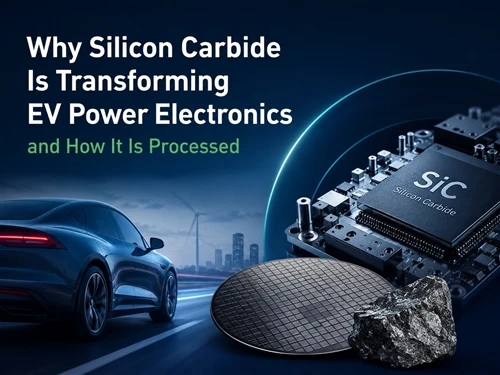
This article explains why SiC is transforming EV power electronics and how precision laser processing technologies help manufacture SiC-related components.
1. Why Is Silicon Carbide Important for EV Power Electronics?
The power electronics system is one of the most critical parts of an electric vehicle.
It controls:
>> Energy conversion
>> Motor operation
>> Battery charging
>> Power distribution
Traditional EV systems mainly rely on silicon (Si) semiconductor devices. However, as EV requirements increase, especially for longer driving range and faster charging, silicon technology is approaching its performance limits.
Silicon carbide provides several advantages that make it suitable for advanced EV applications.
2. Key Advantages of SiC Compared with Traditional Silicon
Higher Efficiency
SiC devices have lower switching losses compared with conventional silicon devices.
This allows:
>> Higher system efficiency
>> Reduced energy loss
>> Improved driving range
Higher Voltage Capability
SiC has a wider bandgap than silicon, allowing devices to operate at higher voltages.
This makes SiC especially suitable for:
>> 800V EV platforms
>> High-power charging systems
>> Advanced inverter designs
Better Thermal Performance
SiC can withstand higher operating temperatures and provides excellent thermal stability.
Benefits include:
>> Reduced cooling requirements
>> Smaller system size
>> Improved reliability
Higher Switching Frequency
Higher switching capability allows engineers to design:
>> Smaller passive components
>> More compact power systems
>> More efficient converters
3. Main Applications of SiC in Electric Vehicles
EV Traction Inverters
The traction inverter converts DC power from the battery into AC power to drive the electric motor.
SiC-based inverters provide:
>> Higher efficiency
>> Lower power loss
>> Better performance at high voltage
This is one of the most important application areas for SiC in EVs.
On-Board Chargers (OBC)
SiC power devices enable:
>> Faster charging
>> Higher power density
>> More compact charger designs
DC/DC Converters
SiC helps improve power conversion efficiency between different voltage levels inside EV systems.
Fast Charging Infrastructure
Beyond vehicles, SiC is also increasingly used in high-power charging equipment due to its efficiency and thermal advantages.
4. Manufacturing Challenges of Silicon Carbide Components
Although SiC provides excellent performance, manufacturing SiC components is challenging.
The same properties that make SiC valuable also make it difficult to process.
Extremely High Hardness
SiC is one of the hardest ceramic materials.
Traditional mechanical machining may suffer from:
>> High tool wear
>> Low processing efficiency
>> Increased production cost
High Brittleness
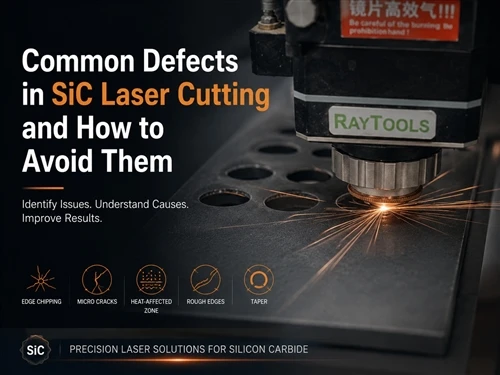
Because SiC has limited fracture toughness, improper processing can cause:
>> Edge chipping
>> Micro cracks
>> Surface damage
Strict Quality Requirements
EV power electronics require high reliability.
Manufacturing processes must control:
>> Dimensional accuracy
>> Surface quality
>> Crack formation
>> Thermal damage
Therefore, advanced processing technologies are required.
5. How Is Silicon Carbide Processed?
Laser processing has become an effective solution for machining advanced SiC ceramic components.
Compared with traditional mechanical methods, laser processing offers:
>> Non-contact machining
>> No tool wear
>> Flexible processing paths
>> Capability for complex geometries
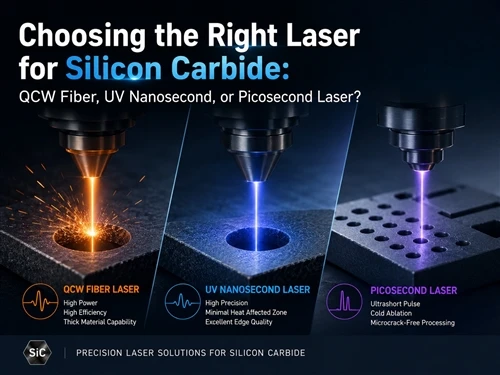
Depending on material thickness and quality requirements, different laser technologies can be selected.
UV Laser Processing for Precision SiC Components
355nm UV laser technology provides:
>> Better material absorption
>> Smaller heat-affected zones
>> Higher processing precision
It is suitable for:
>> Thin SiC components
>> Precision ceramic parts
>> Applications requiring excellent edge quality
QCW Fiber Laser Processing for Thicker SiC Parts
For thicker SiC ceramics requiring higher processing efficiency, QCW fiber laser solutions provide stronger material removal capability.
Suitable applications include:
>> Structural SiC components
>> Thicker ceramic parts
>>Industrial applications requiring productivity
6. YCLaser: Precision Laser Processing Solutions for SiC Ceramics
As a professional ceramic laser processing equipment manufacturer, WHYC Laser specializes in precision laser cutting, drilling, and micromachining solutions for advanced ceramics, including silicon carbide (SiC), silicon nitride (Si₃N₄), aluminum nitride (AlN), alumina (Al₂O₃), and zirconia (ZrO₂).
For SiC applications in EV and power electronics, WHYC Laser provides customized solutions based on:
>> Material thickness
>> Component structure
>> Accuracy requirements
>>Production efficiency
Our laser processing systems are designed for:
>> SiC ceramic cutting
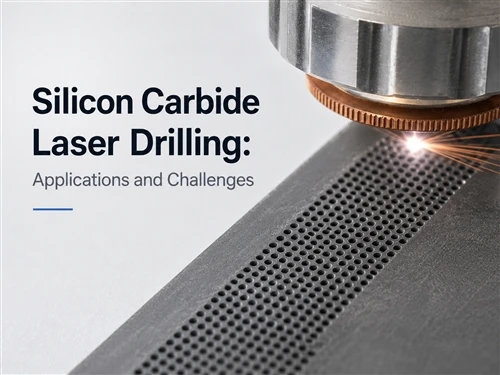
>> Precision drilling
>> Complex contour machining
>> Prototype testing and process development
Key technologies include:
>> High-precision motion systems
>> CCD vision alignment
>> Optimized laser scanning strategies
>> Stable energy control
Before equipment investment, customers can conduct sample testing to evaluate:
>>Cutting quality
>> Edge chipping control
>> Crack prevention
>>Processing efficiency
This helps manufacturers develop reliable SiC processing solutions for next-generation power electronics applications.
Conclusion
Silicon carbide is becoming a critical material for the future of EV power electronics due to its superior efficiency, high-voltage capability, and excellent thermal performance.
With precision laser cutting, drilling, and micromachining solutions, YCLASER helps manufacturers overcome SiC processing challenges and achieve reliable production of advanced ceramic components for EV, semiconductor, and power electronics applications.