Selecting the right laser for alumina ceramic cutting is not simply about the maximum thickness a machine can cut. In production, edge quality, dimensional accuracy, efficiency, and process stability are equally important.
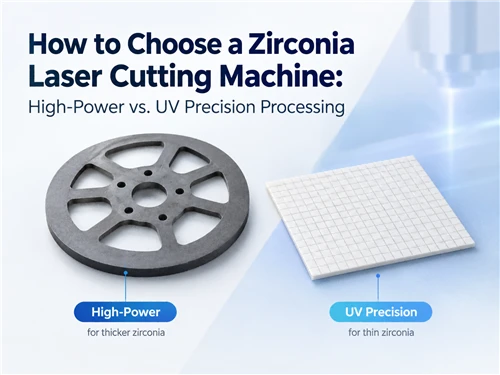
For most manufacturers, 355nm UV lasers and QCW fiber lasers are the two most practical solutions. This guide explains their recommended applications and helps you choose the right technology for your project.
355nm UV Laser
Best for Thin, High-Precision Alumina Ceramics
UV lasers are widely used for manufacturing:
---- Ceramic substrates
---- Electronic packaging components
---- LED ceramic carriers
---- Precision insulating parts
They are ideal for thin alumina ceramics, where clean edges and minimal thermal damage are critical.
Key advantages include:
---- Excellent dimensional accuracy
---- Low heat-affected zone
---- Minimal edge chipping
---- Smooth cutting quality
As material thickness increases, more cutting passes are required, reducing processing efficiency and making edge quality more difficult to maintain.
Recommended for: Thin ceramic substrates and precision electronic components.
QCW Fiber Laser
Best for Medium-Thickness Ceramic Components
QCW fiber lasers deliver higher material removal rates and are better suited for thicker alumina ceramic parts.
Typical applications include:
---- Industrial ceramic components
---- Electrical insulation parts
---- Wear-resistant ceramics
Compared with UV lasers, QCW systems provide:
---- Higher cutting efficiency
---- Better performance on thicker materials
---- Greater productivity for industrial manufacturing
Because QCW lasers introduce more thermal energy, some applications may require additional edge finishing when high cosmetic quality is required.
Recommended for: Medium-thickness structural ceramic parts where productivity is the priority.
What Determines Maximum Cutting Thickness?
The practical cutting limit depends on several factors rather than laser power alone.
The most important include:
---- Alumina grade and material properties
---- Laser configuration and process optimization
---- Part geometry and feature complexity
Optimizing these factors usually has a greater impact on production quality than simply increasing laser power.
Which Laser Is Right for Your Application?
Application Recommended Laser
Thin ceramic substrates 355nm UV Laser
Medium-thickness ceramic components QCW Fiber Laser
In general, choose UV lasers when precision and edge quality are the priority, and QCW lasers when higher productivity is required for thicker ceramic parts.
Frequently Asked Questions
Can UV lasers cut thick alumina ceramics?
---- Yes, but processing efficiency decreases as thickness increases. UV lasers are generally better suited to thin, high-precision ceramic components.
Which laser is better for thicker alumina ceramics?
---- For many industrial applications, QCW fiber lasers provide higher productivity and better overall performance on medium-thickness ceramic parts.
Choose the Right Ceramic Laser Solution
---- Every alumina ceramic application has different requirements for thickness, accuracy, and production volume. YCLaser specializes in 355nm UV laser cutting, QCW laser cutting, laser drilling, laser scribing, and precision laser micromachining for advanced ceramics.
Whether you're developing a new product or optimizing an existing production line, our engineers can recommend the most suitable laser solution based on your material, design, and manufacturing requirements.
👉 Contact YCaser to discuss your application or send us your drawings for a customized ceramic laser processing recommendation.