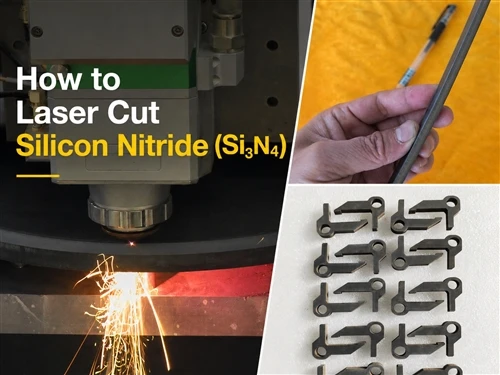
Silicon nitride (Si₃N₄) is an advanced engineering ceramic widely recognized for its outstanding combination of high mechanical strength, excellent fracture toughness, wear resistance, thermal stability, and electrical insulation. Unlike conventional ceramics, silicon nitride maintains excellent mechanical performance under extreme temperatures and thermal cycling, making it one of the most reliable materials for demanding industrial environments.
Today, silicon nitride is widely used in EV power modules, semiconductor equipment, aerospace components, ceramic bearings, mechanical seals, and high-temperature furnace systems. As advanced manufacturing continues to evolve, it is increasingly replacing metals and conventional ceramics in applications where long service life and reliability are critical.
How Is Silicon Nitride Ceramic Manufactured?
The performance of silicon nitride depends heavily on its sintering process. Four manufacturing methods are commonly used:
Reaction-Bonded Silicon Nitride (RBSN)
RBSN is produced by nitriding silicon powder. It offers excellent dimensional stability with minimal shrinkage, making it suitable for complex shapes. However, its relatively high porosity limits mechanical strength, so it is mainly used for general wear-resistant components and industrial fixtures.
Hot-Pressed Silicon Nitride (HPSN)
Hot pressing combines high temperature with mechanical pressure to achieve near-full density and excellent mechanical properties. This process produces premium-grade materials for aerospace components, cutting tools, and other high-performance applications, although production costs are relatively high.
Gas Pressure Sintered Silicon Nitride (GPSN)
GPSN is the most widely used industrial process today. It provides an excellent balance between mechanical performance, manufacturing flexibility, and production cost, making it suitable for power electronics substrates, ceramic bearings, nozzles, and structural components.
Pressureless Sintered Silicon Nitride (SSN)
SSN offers efficient large-scale production for standard ceramic plates and general engineering applications while maintaining good overall mechanical performance.
Key Properties of Silicon Nitride
Silicon nitride is often selected because it combines multiple performance advantages that few engineering materials can match.
| Property | Silicon Nitride |
| Density | ~3.2 g/cm³ |
| Hardness | Mohs 8–9 |
| Fracture Toughness | 6–8 MPa·m¹ᐟ² |
| Maximum Continuous Service Temperature | Up to approximately 1200°C in air |
| Electrical Insulation | Excellent |
| Wear Resistance | Excellent |
| Thermal Shock Resistance | Outstanding |
Compared with alumina ceramics, silicon nitride offers significantly higher fracture toughness and impact resistance. Compared with aluminum nitride, it provides superior mechanical reliability, although aluminum nitride offers higher thermal conductivity.
These balanced properties make silicon nitride one of the preferred materials for high-temperature structural applications.
Typical Applications
Thanks to its exceptional performance, silicon nitride is used across numerous high-end industries.
Power Electronics
Silicon nitride substrates are widely used in EV inverters, SiC power modules, and IGBT packaging because of their excellent mechanical reliability and electrical insulation.
Semiconductor Manufacturing
Vacuum chucks, guide plates, wafer handling components, and precision fixtures benefit from silicon nitride's wear resistance and dimensional stability.
Aerospace
High-temperature bearings, sensor protection tubes, turbine components, and engine hardware use silicon nitride to reduce weight while maintaining strength under extreme temperatures.
Industrial Equipment
Mechanical seals, ceramic bearings, nozzles, furnace fixtures, and wear-resistant components deliver significantly longer service life than traditional metal parts.
Manufacturing Challenges
Although silicon nitride offers exceptional performance, it is also one of the most difficult engineering ceramics to machine.
Its high hardness causes rapid tool wear during conventional grinding, while its brittle nature increases the risk of edge chipping and microcracks during mechanical machining. Producing precision holes, complex contours, or thin ceramic substrates can therefore become both expensive and time-consuming.
For manufacturers, machining costs often represent a significant portion of the total component cost.
Why Precision Laser Machining Is Becoming the Preferred Solution
Precision laser processing provides an efficient alternative for machining silicon nitride components.
Unlike conventional machining, laser processing is completely non-contact, eliminating mechanical cutting forces that may damage brittle ceramics. Optimized laser parameters also help reduce edge chipping and improve dimensional consistency, particularly for precision holes and complex profiles.
Laser machining is especially suitable for:
Precision cutting of silicon nitride substrates
Micro-hole drilling
Complex contour machining
Thin ceramic plates
High-precision prototype development
For many applications, laser processing reduces secondary finishing operations while improving production efficiency.
WHYC Laser Solutions for Silicon Nitride
YCLaser specializes in precision laser processing equipment for advanced ceramics, including silicon nitride.
Its ceramic laser systems support precision cutting, drilling, profiling, and customized machining for a wide range of Si₃N₄ components. Standard production solutions cover material thicknesses from 0.2 mm to 11 mm, while thicker customized components can also be evaluated through sample testing. WHYC Laser has successfully processed silicon nitride up to 21 mm under customized process conditions for specific R&D and special-order applications.
In addition to laser equipment, YCLaser also provides contract machining services, helping manufacturers validate designs and optimize production before investing in equipment.
Conclusion
Silicon nitride has become one of the most important advanced engineering ceramics because it combines high strength, excellent fracture toughness, superior wear resistance, thermal stability, and electrical insulation in a single material.
As demand continues to grow across electric vehicles, semiconductor manufacturing, aerospace, and industrial automation, precision machining technologies will play an increasingly important role in unlocking the full potential of silicon nitride components.
Whether manufacturing high-performance substrates, wear-resistant mechanical parts, or complex structural ceramics, selecting the right machining process is just as important as selecting the right material. Precision laser processing is helping manufacturers improve quality, reduce waste, and achieve more reliable production of advanced silicon nitride components.