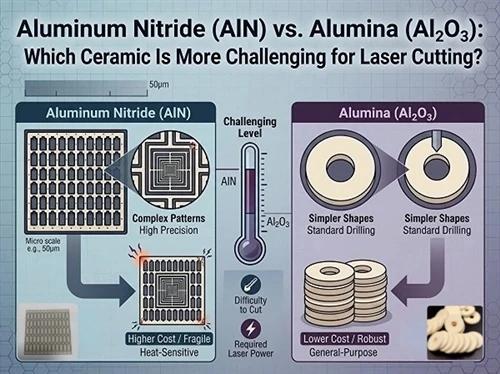
When choosing a ceramic laser cutting machine, many engineers assume that higher laser absorption automatically means easier machining. In reality, laser cutting performance depends on the balance between laser absorption, thermal conductivity, thermal expansion, and crack resistance.
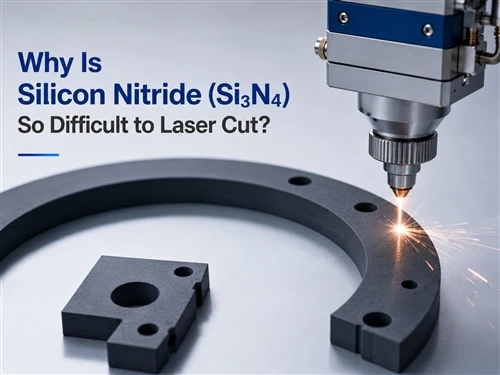
Although silicon nitride (Si₃N₄) absorbs laser energy better than alumina (Al₂O₃), it remains one of the most difficult engineering ceramics to process because of its extreme sensitivity to thermal stress.
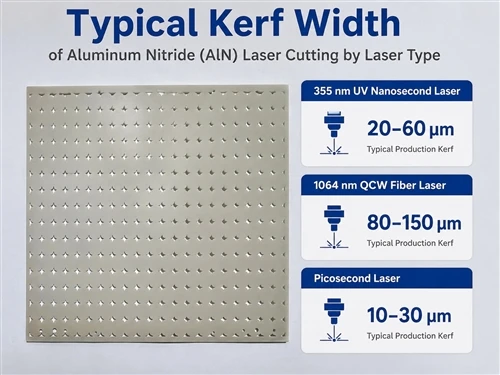
This article compares QCW fiber lasers, 355 nm UV nanosecond lasers, and picosecond lasers for industrial production.
Material Properties That Affect Laser Cutting
| Property | Alumina (Al₂O₃) | Silicon Nitride (Si₃N₄) | Impact on Laser Cutting |
| 1064 nm absorption | 5–10% | 25–40% | Alumina often requires an absorptive coating; Si₃N₄ absorbs better but develops much higher thermal stress. |
| 355 nm absorption | 40–50% | 50–65% | UV processing is effective for both materials, with slightly better absorption for Si₃N₄. |
| Thermal expansion | 7–8 ppm/°C | 2.8–3.3 ppm/°C | Lower expansion causes higher residual stress and crack risk. |
| Thermal conductivity | 22–32 W/m·K | 16–22 W/m·K | Si₃N₄ dissipates heat more slowly, increasing heat accumulation. |
1. QCW 1064 nm Fiber Laser
Alumina
Mature production process
Wide processing window
Stable contour cutting
High productivity
The main limitation is low infrared absorption, which is commonly solved with an absorptive coating before cutting.
Difficulty: ★★☆☆☆
Silicon Nitride
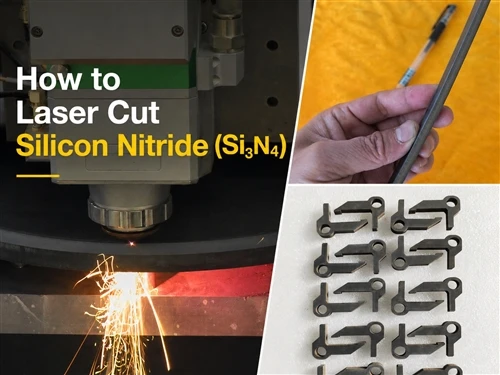
Although Si₃N₄ absorbs infrared light better, it is much more prone to thermal cracking.
Typical issues include:
Through-thickness microcracks
Edge chipping
Delayed cracking
Reduced cutting speed due to shallow-layer scanning
The process window is significantly narrower than for alumina.
Difficulty: ★★★★★
2. 355 nm UV Nanosecond Laser
Alumina
UV laser cutting is already a mature industrial solution.
Typical advantages include:
Small HAZ
Stable micro-hole machining
Low chipping
High production yield
Difficulty: ★★☆☆☆
Silicon Nitride
UV lasers greatly reduce thermal damage but cannot completely eliminate thermal stress.
Industrial production usually requires:
Higher laser power (20–30 W)
Multi-pass shallow cutting
High-purity nitrogen assist gas
Optimized cooling strategies
Compared with alumina, processing time is typically 50–100% longer.
Difficulty: ★★★★☆
3. Picosecond Laser
Alumina
Picosecond lasers provide:
Near-zero HAZ
No recast layer
Excellent edge quality
Stable precision machining
Difficulty: ★★☆☆☆
Silicon Nitride
Ultrashort pulses significantly reduce crack formation, but Si₃N₄ still requires:
Lower pulse energy
More scanning passes
Longer machining time
Production efficiency generally remains 30% lower than alumina.
Difficulty: ★★★☆☆
Difficulty Comparison
| Application | Easier Material |
| QCW contour cutting | Al₂O₃ |
| UV precision cutting | Al₂O₃ |
| Micro-hole drilling | Al₂O₃ |
| Ultra-thin substrates | Al₂O₃ |
| Picosecond precision machining | Al₂O₃ (slightly) |
Why Is Silicon Nitride More Difficult?
The biggest challenge is not laser absorption.
Instead, silicon nitride combines several unfavorable characteristics:
Lower thermal conductivity
Extremely low thermal expansion
High residual thermal stress
Greater crack sensitivity
Narrower process window
As a result, even with UV or picosecond lasers, manufacturers usually need:
More cutting passes
Lower energy per pass
Stronger cooling
Longer processing time
These factors make Si₃N₄ significantly more difficult to process than alumina in mass production.
Recommended Laser Solutions
| Application | Recommended Solution |
| Cost-effective contour cutting | 150 W QCW Fiber Laser + Alumina |
| Precision micro-machining | 355 nm UV Nanosecond Laser |
| Thin Si₃N₄ substrates | 20–30 W UV Laser + Multi-pass Cutting + Nitrogen Assist |
| Highest reliability Si₃N₄ components | 355 nm Picosecond Laser + Advanced Cooling |
Conclusion
While silicon nitride absorbs laser energy more efficiently than alumina, its poor heat dissipation and extremely high thermal stress sensitivity make it one of the most challenging ceramics for laser processing.
For high-yield industrial production, 355 nm UV lasers remain the preferred solution for precision Si₃N₄ machining, while QCW fiber lasers are better suited to high-efficiency alumina processing.
Need a laser solution for advanced ceramics?
YCLASER specializes in precision laser cutting of Al₂O₃, Si₃N₄, AlN, ZrO₂, SiC, DBC and DPC ceramic substrates. We provide free sample testing, process optimization, and customized laser solutions for both prototyping and mass production. Contact us to discuss your application.