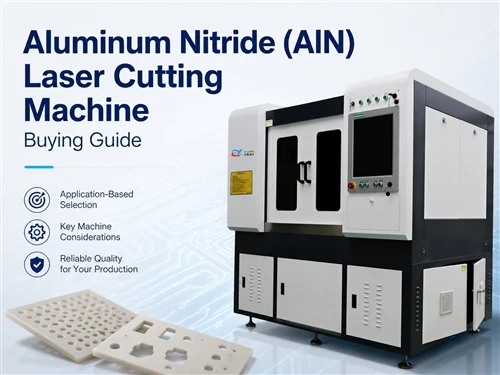
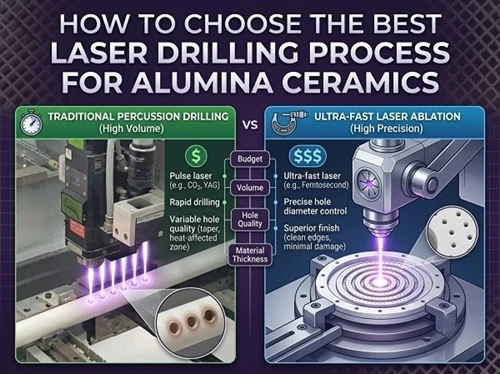
Choosing the right Aluminum Nitride Laser Cutting Machine is not simply about selecting the highest laser power. The best solution depends on your material thickness, metallization, precision requirements, production volume, and automation needs.
This guide outlines the key factors to consider before purchasing an AlN laser cutting system.
1. Select the Machine Based on Your Application
Different AlN products require different laser technologies.
| Typical Application | Recommended Machine |
| Thin semiconductor substrates (0.1–0.8 mm) | 355 nm UV Laser Cutting Machine |
| DBC / DPC ceramic substrates | 355 nm UV Laser Cutting Machine |
| Thick AlN structural ceramics (1–3 mm) | QCW Fiber Laser Cutting Machine |
| Ultra-precision MEMS or microfluidic devices | Picosecond Laser System |
| Mixed production (thin + thick AlN) | Dual-Laser Processing System |
For most electronic ceramic applications, 355 nm UV Laser Cutting Machines provide the best balance between cutting quality and production stability.
2. Compare Laser Technologies
| Machine Type | Best For | Advantages | Limitations |
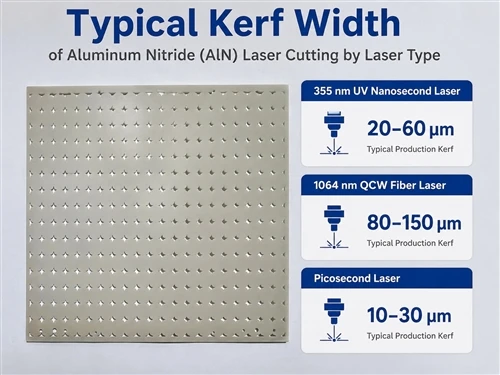
| 355 nm UV Laser Cutting Machine | Thin AlN substrates | Narrow kerf, low HAZ, excellent edge quality | Lower speed on thick materials |
| QCW Fiber Laser Cutting Machine | Thick AlN ceramics | Higher cutting efficiency, lower operating cost | Larger kerf and heat-affected zone |
| Picosecond Laser | Ultra-precision processing | Minimal thermal damage | Higher equipment investment |
Select the laser type according to your product requirements rather than laser power alone.
3. Request Sample Testing
Before placing an order, ask the supplier to cut your own AlN samples.
Verify:
Cutting quality
Dimensional accuracy
Production stability
Yield rate
Repeatability
Testing with your actual products provides the most reliable basis for equipment selection.
4. Match Automation to Production Volume
| Production Scale | Recommended Configuration |
| R&D and prototyping | Manual loading |
| High-volume manufacturing | Fully automatic loading and unloading |
Selecting the appropriate automation level helps balance investment cost and production efficiency.
5. Evaluate Machine Configuration
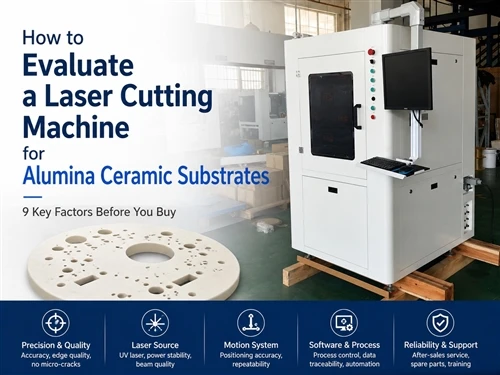
For precision aluminum nitride (AlN) machining, the machine should include: a highly stable linear motor motion system, a marble machine base, CCD vision alignment, closed-loop positioning control, automatic edge detection and reference point recognition. A stable platform is crucial for maintaining dimensional consistency during long production runs.
6. Consider Operating Cost
Besides the initial purchase price, evaluate the total cost of ownership, including:
Laser source lifetime
Maintenance requirements
Consumable costs
Spare parts availability
Technical support
Process optimization services
Lower operating costs can significantly improve long-term production efficiency.
The best Aluminum Nitride Laser Cutting Machine is the one that matches your application requirements rather than simply offering the highest laser power.
Evaluating the machine based on real production requirements, sample testing, and long-term operating cost will help you select a system that delivers both high quality and reliable manufacturing performance
Ready to Test Your Ceramic Parts?
At YCLASER, we specialize in laser cutting and drilling solutions for advanced ceramics. If you're evaluating a new project or looking to improve your current process, we're here to help.
✓ Free sample testing
✓ Process evaluation by experienced engineers
✓ Customized laser solutions for your application
Send us your drawings or samples today and discover the best laser processing solution for your ceramic components.