Laser drilling has become the preferred manufacturing method for producing precision micro holes in alumina ceramic substrates. From semiconductor packaging and ceramic PCBs to power modules and medical devices, different applications require different drilling strategies.
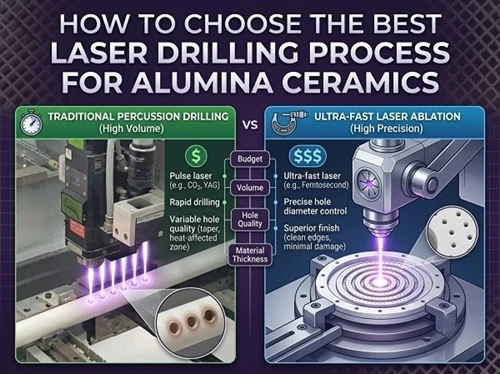
However, there is no single laser drilling process that fits every application. The best solution depends on factors such as material thickness, hole diameter, dimensional accuracy, production volume, and reliability requirements.
This guide explains the key considerations when selecting the most suitable laser drilling process for alumina ceramics.
---
Start with Your Application Requirements
Before selecting equipment or a drilling process, clearly define your application requirements.
The most important questions include:
* What is the alumina substrate thickness?
* What is the required hole diameter?
* How many holes are produced per part?
* What production volume is required?
* What level of hole quality is needed?
* Are there specific requirements for taper, edge chipping, or sidewall finish?
The answers to these questions determine which laser drilling technology will provide the best balance between quality and productivity.
---
Consider Material Thickness
Material thickness is one of the first factors to evaluate.
Thin Alumina Substrates (≤0.635 mm)
Thin ceramic substrates generally require fewer laser pulses to penetrate, making them well suited for high-speed laser percussion drilling.
Typical applications include:
* Ceramic PCBs
* LED substrates
* Sensor substrates
* General electronic ceramics
When production throughput is the priority, percussion drilling is often the most economical solution.
---
Thick Alumina Substrates (>1 mm)
As material thickness increases, drilling becomes more challenging.
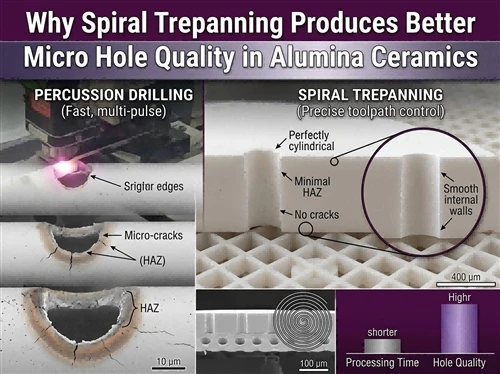
Additional laser energy is required to penetrate the material, increasing thermal stress and the risk of taper, edge chipping, or micro-cracks.
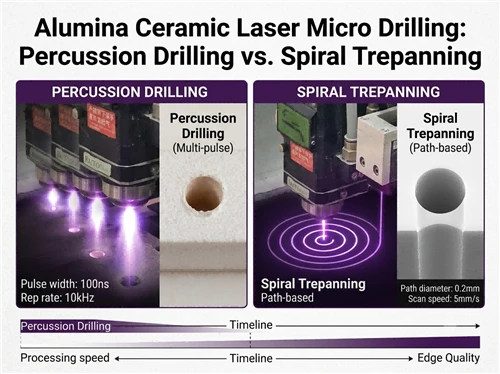
For thicker substrates, spiral trepanning is generally preferred because it removes material gradually and provides better control over hole geometry.
---
Evaluate Hole Diameter
Hole size has a significant impact on process selection.
Hole Diameter ≥100 μm
For larger micro holes, percussion drilling usually provides excellent productivity while maintaining acceptable hole quality.
It is particularly suitable for large arrays of identical holes where manufacturing efficiency is critical.
---
Hole Diameter <100 μm
As hole diameter decreases, dimensional accuracy becomes increasingly important.
Applications requiring ultra-small micro holes typically benefit from spiral trepanning because it offers:
* Better roundness
* Lower taper
* Reduced edge chipping
* Improved dimensional consistency
---
Balance Speed and Quality
Many manufacturers initially focus on drilling speed.
However, the fastest process is not always the most productive.
For example, a high-speed drilling process that generates excessive defects may require additional inspection, cleaning, or rework, reducing overall manufacturing efficiency.
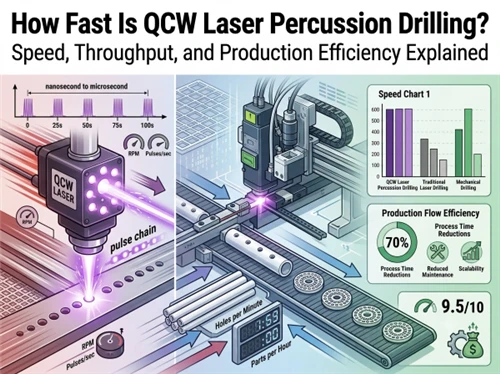
Instead of evaluating holes per second, manufacturers should focus on qualified parts per hour.
This approach provides a more accurate measurement of real production performance.
---
Understand Your Quality Requirements
Different industries have very different quality standards.
Standard Industrial Components
Applications with relatively relaxed tolerances often prioritize:
* High throughput
* Stable production
* Lower manufacturing cost
Percussion drilling is frequently the preferred solution.
---
High-Reliability Electronic Components
Products used in semiconductor, automotive, aerospace, and medical industries typically require:
* Low taper
* Minimal edge chipping
* Smooth sidewalls
* Excellent dimensional consistency
For these applications, spiral trepanning generally provides better long-term manufacturing reliability.
---
Match the Process to Production Volume
Production volume also influences equipment selection.
Prototype Development
For small production batches, process flexibility is often more important than maximum speed.
Medium-Volume Manufacturing
Manufacturers usually seek a balance between productivity and quality.
Equipment capable of supporting both percussion drilling and spiral trepanning offers greater flexibility for different products.
High-Volume Production
Large-scale manufacturing emphasizes automation, stable cycle times, and consistent product quality.
For suitable applications, flying percussion drilling combined with automated handling systems can significantly increase throughput.
Typical Process Selection Guide
The following table summarizes common recommendations.
| Requirement | Recommended Process |
| Thin alumina substrate | Percussion Drilling |
| Thick alumina substrate | Spiral Trepanning |
| Hole diameter ≥100 μm | Percussion Drilling |
| Hole diameter <100 μm | Spiral Trepanning |
| High-volume production | Percussion Drilling |
| Minimal edge chipping | Spiral Trepanning |
| Low taper | Spiral Trepanning |
| Semiconductor packaging | Spiral Trepanning |
| General industrial components | Percussion Drilling |
These recommendations serve as general guidelines. Actual process selection should always be validated through sample testing and process optimization.
---
Don't Choose Based on Speed Alone
One common mistake is selecting equipment solely based on its advertised drilling speed.
Factors such as laser source, beam quality, motion control, process stability, and engineering support all have a significant impact on long-term production performance.
An optimized laser process can often reduce manufacturing costs more effectively than simply purchasing a faster machine.
When evaluating suppliers, consider:
* Application experience
* Sample processing capability
* Process development support
* Equipment reliability
* After-sales service
* Future production scalability
A complete manufacturing solution delivers greater value than speed specifications alone.
---
Why Process Testing Is Essential
Even when processing the same alumina material, results can vary depending on:
* Material purity
* Surface finish
* Hole geometry
* Laser parameters
* Fixturing
* Production environment
For this reason, professional sample testing remains the most reliable method for selecting the optimal drilling process.
Testing allows manufacturers to evaluate hole quality, productivity, and process stability before investing in production equipment.
---
Conclusion
Selecting the best laser drilling process for alumina ceramics requires balancing productivity, precision, and manufacturing reliability.
Percussion drilling is generally the preferred solution for thin substrates, larger hole diameters, and high-volume production. Spiral trepanning offers superior hole quality and dimensional control for demanding applications where precision is the highest priority.
Rather than focusing on drilling speed alone, manufacturers should evaluate the complete manufacturing process, including yield, consistency, operating cost, and long-term production requirements.
The right laser drilling solution is the one that delivers the best overall manufacturing performance for your specific application.
Why YCLASER?
YCLASER specializes in precision laser micromachining solutions for advanced ceramics, including alumina (Al₂O₃), aluminum nitride (AlN), zirconia (ZrO₂), silicon nitride (Si₃N₄), and silicon carbide (SiC).
With extensive application experience in ceramic laser drilling, cutting, scribing, and profiling, our engineering team works closely with customers to evaluate materials, optimize drilling processes, and recommend the most suitable solution for their production requirements.
From sample testing and process development to customized equipment and responsive after-sales support, YCLASER is committed to helping manufacturers improve product quality, increase production efficiency, and build a scalable manufacturing platform for future growth.
Whether you are developing a new ceramic application or expanding mass production, YCLASER is ready to support your project with reliable laser technology and professional engineering expertise.(contact us now)