Direct Bonded Copper (DBC) is a ceramic surface metallization technology. It directly bonds ceramics (Al₂O₃, BeO, AlN, etc.) to a copper substrate. DBC is widely used for metalizing oxide ceramics, especially aluminum oxide substrates, in power electronic modules, semiconductor cooling, and LED device packaging. Its main purpose is to improve heat dissipation from integrated circuit chips.
Technical Principles
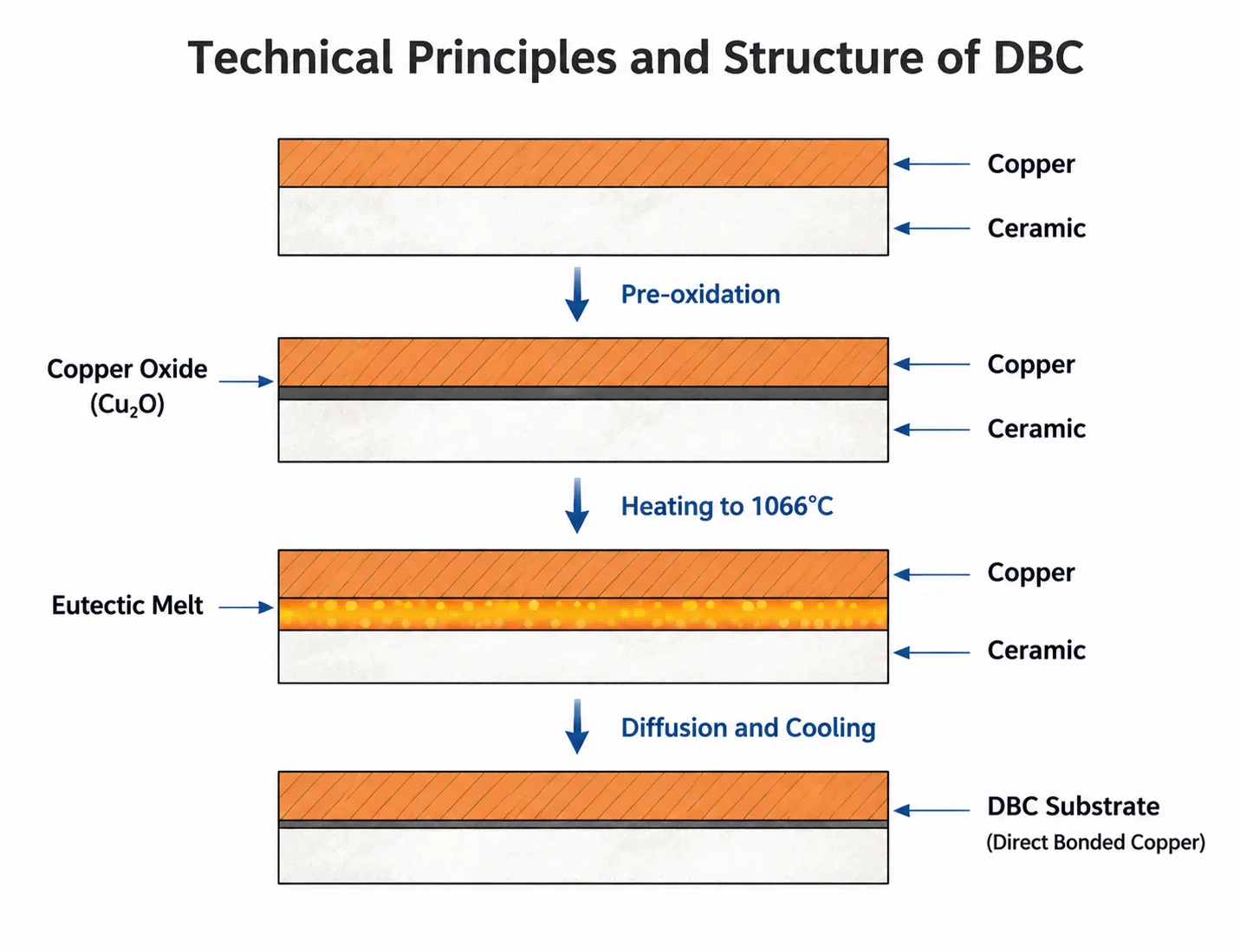
Copper sheets are placed on Al₂O₃ substrates and heated in an oxygen-containing atmosphere to 1066–1083°C. This process directly bonds the copper to the Al₂O₃. The mechanism is generally described as follows: during firing, a controlled oxygen level enables copper to bond with Al₂O₃ below copper's melting point (1083°C).
Within 1066–1083°C, copper and oxygen form a Cu-O eutectic. The eutectic wets the contacting surfaces of copper foil and Al₂O₃ and reacts with Al₂O₃ to form composite oxides like Cu(AlO₂), acting as solder to firmly bond the two materials.
For non-oxide ceramics such as AlN, the Cu-O eutectic wets poorly. A thin Al₂O₃ transition layer must first be formed on the AlN surface, then bonded to copper via the Al₂O₃ layer, producing Al₂O₃-DBC or AlN-DBC. The preparation process is shown in the figure. The resulting DBC substrates can then be etched to obtain the desired patterns.
In recent years, DBC technology has rapidly developed. DBC substrates now have greatly improved mechanical strength and provide a cost-effective material for multi-chip power semiconductor assemblies.
Laser processing of DBC substrates has become the mainstream method. YCLASER offers free sample testing and small-batch contract processing services for global clients.