Silicon Carbide (SiC): The "King" of Third-Generation Semiconductors & Advanced Ceramics
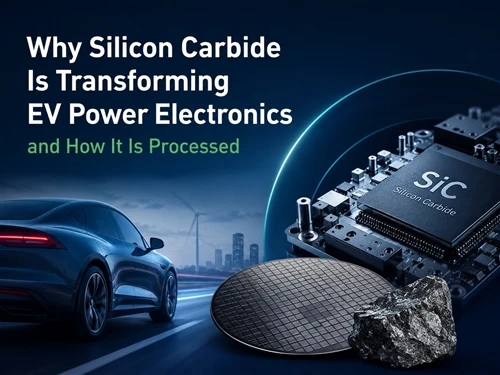
Silicon Carbide (SiC) has earned its reputation as a cornerstone of modern industrial evolution. Whether as a wide-bandgap semiconductor or a high-performance engineering ceramic, SiC is rapidly displacing traditional materials in New Energy Vehicles (EVs), 5G infrastructure, and Aerospace due to its unmatched physical and chemical properties.
Core Advantages of Silicon Carbide
1. Exceptional Thermal Management
Thermal Conductivity: 120–490 W/(m·K) (varying by purity).
Performance: Over 50x that of stainless steel and comparable to pure copper.
Impact: Enables rapid heat dissipation in high-power density environments, preventing thermal failure in EV inverters and 5G base stations.
2. Superior Semiconductor Characteristics
Compared to traditional Silicon (Si), SiC offers:
3x wider Bandgap (3.2 eV): Exceptional high-voltage and temperature resistance.
10x Breakdown Electric Field Strength: Allows for thinner, more efficient power devices.
2x Electron Saturation Velocity: Enables faster switching speeds, reducing device size by 30–50%.
3. Extreme Temperature & Chemical Stability
Thermal Resilience: Operates continuously above 1600°C with a melting point exceeding 2700°C.
Chemical Inertness: Highly resistant to most acids and alkalis. Its self-healing $SiO_2$ oxidation layer makes it ideal for chemical pumps and semiconductor etching equipment.
Low Expansion: A low coefficient of thermal expansion ($4.0 \times 10^{-6}/K$) ensures incredible thermal shock resistance.
4. Ultra-High Hardness & Lightweight Structure
Hardness: Mohs 9.5 (second only to diamond).
Density: At 3.2 g/cm³, it is only 40% the weight of steel but offers superior specific stiffness.
Applications: Perfect for lightweight satellite reflectors, bulletproof armor, and precision wear-resistant bearings.
Selection Guide: Silicon Carbide (SiC) vs. Aluminum Nitride (AlN)
Choosing the right material is critical for balancing performance and cost-efficiency. Use this guide for your application:
Application Scenario Recommended Material Why?
High-Power Chip Substrates -----AlN (Aluminum Nitride) -----Superior electrical insulation + thermal matching with Silicon.
5G RF / GaN Devices -----SiC (Silicon Carbide) -----Optimal thermal conductivity + GaN epitaxial compatibility.
LED Packaging Brackets----- AlN -----Industry standard for insulation and cost-to-performance ratio.
Industrial Wear Parts (Nozzles/Bearings) -----SiC -----Unparalleled hardness and 1600°C+ temperature resistance.
EV Main Drive Inverters----- AlN Substrate + SiC Device-----SiC handles the power switching; AlN provides the necessary insulation.
Budget-Sensitive Thermal Projects----- SiC Ceramics----- More cost-effective than AlN while maintaining high thermal performance.
Why Choose Silicon Carbide for Your Next Project?
From DBC/DPC/AMB ceramic substrates to precision laser-processed components, Silicon Carbide is the definitive choice for industries requiring high-speed, high-voltage, and high-temperature reliability. Its ability to transition from an insulator to a high-performance semiconductor makes it the most versatile material in the 21st-century manufacturing landscape.