Key Insights:
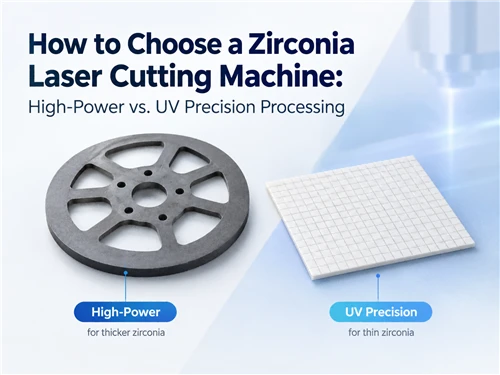
Thick sintered ceramics can be processed stably with fiber or QCW lasers. However, ultrathin sheets ≤0.2 mm are prone to cracking under the thermal stress of fiber/QCW lasers, making ultraviolet (UV) cold processing the preferred option. Green state alumina is compatible with all laser types across its full thickness, offering the lowest processing difficulty, though shrinkage compensation must be considered in advance. This makes it ideal for complex-shaped parts with moderate dimensional accuracy requirements.
Underlying Logic:
Sintered Ceramics = Dense Crystalline Structure, High Hardness, Zero Porosity, Extremely Brittle
Thermal conductivity is extremely poor; heat cannot dissipate effectively.
When processing sintered alumina, one must not rely solely on material thickness; a comprehensive assessment considering thickness, hole diameter, and drilling method is required:
Thickness ≥ 0.4–0.5 mm
Both continuous-wave fiber lasers and QCW (quasi-continuous wave) lasers can reliably perform drilling and cutting operations; these processes are mature and suitable for mass production.
For large hole diameters (≥ 0.3 mm), direct point-drilling (percussion drilling) can be applied.
For micro-holes (≤ 0.15 mm), direct point-drilling leads to stress concentration and a high risk of hole blowout; spiral drilling is the preferred method.
Thickness 0.3–0.4 mm
QCW lasers are capable of processing this thickness range; direct point-drilling is used for large hole diameters. For micro-holes, processing requires low power, slow feed rates, extended pulse durations, and spiral contour cutting; the resulting yield rate is generally moderate.
Thickness ≤ 0.2 mm (Ultra-thin Sheets)
The processing risk associated with QCW lasers rises significantly; only large hole diameters can be processed via direct point-drilling.
For micro-holes, direct point-drilling carries an extremely high risk of causing the entire sheet to crack or chip at the edges; UV lasers combined with spiral drilling are the preferred solution. QCW spiral drilling may be attempted only on a small-batch, experimental basis.
Application Recommendations:
Prefer Green State Alumina:
Suitable for: large-volume alumina structural parts, porous ceramics, complex cavities, deep-hole machining, microfluidic channels, and parts where shrinkage compensation is acceptable.
UV or nanosecond lasers provide stable processing, making this the mainstream industrial solution.
Prefer Sintered Alumina:
Suitable for: ultra-high-precision, extremely small parts without shrinkage tolerance, such as micro-insulation terminals, precision ceramic rings, wafer holders, commonly used in semiconductor, 5G, medical, and aerospace applications.
Conclusion:
There is no absolute "better" between green state and sintered alumina. The choice depends on precision requirements, batch size, cost budget, and post-sintering processes. YCLaser offers professional pre-sales support to assess material characteristics, laser processing challenges, and suitable applications. We help you determine the optimal choice under different conditions. Contact us to discuss your specific requirements.