Silicon carbide laser drilling is a non-contact machining process that uses a focused laser beam to remove silicon carbide material through localized energy absorption. (High-energy laser pulses form precise holes with minimal mechanical stress, making it an important technology for manufacturing high-precision, high-reliability complex silicon carbide components.)
Unlike traditional mechanical drilling, laser drilling does not require physical cutting tools. The process avoids problems such as:
>> Tool wear
>> Mechanical stress
>> Material deformation
>> Difficult machining of complex structures
By controlling laser parameters including wavelength, pulse width, frequency, power, and scanning strategy, manufacturers can achieve precise holes in SiC ceramics for different applications.
Common laser drilling methods include:
1. Percussion Laser Drilling
Percussion drilling uses multiple laser pulses at a fixed position to gradually remove material.
Advantages:
>> High drilling speed
>> Suitable for large quantities of holes
>> Good efficiency for repeated micro-hole processing
It is commonly used for applications requiring many holes with moderate precision requirements.
2. Trepanning Laser Drilling
Trepanning uses a programmed laser path to cut the hole contour.
Advantages:
>> Better hole roundness
>> Improved dimensional accuracy
>> Suitable for larger diameter holes
This method is preferred when hole quality and geometry are critical.
Applications of Silicon Carbide Laser Drilling
1. SiC Power Semiconductor Components
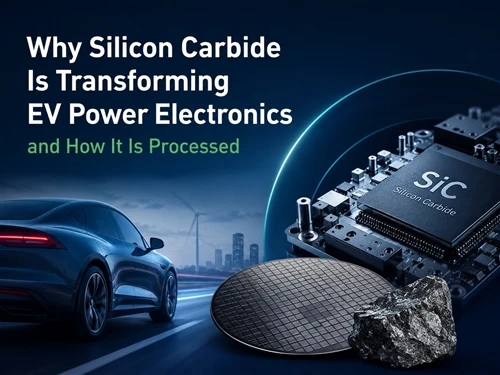
The rapid development of electric vehicles and renewable energy has increased demand for SiC power devices.
SiC components are widely used in:
>> EV inverters
>> Charging systems
>> Industrial power supplies
>> Solar and energy storage systems
Laser drilling can be used for precision holes, alignment features, and structural processing of SiC-based components.
The advantages include:
>> High positioning accuracy
>> Low mechanical damage
>> Compatibility with complex designs
2. Thermal Management Components
Because SiC has excellent thermal conductivity and high-temperature resistance, it is used in advanced heat dissipation structures.
Laser drilling enables the manufacturing of:
>> Cooling channels
>> Heat dissipation holes
>> Flow structures
These microstructures help improve thermal performance in high-power electronic systems.
3. SiC Ceramic Structural Parts
SiC ceramics are widely used in demanding environments, including:
>> Semiconductor equipment components
>> Aerospace parts
>> High-temperature fixtures
>> Precision mechanical structures
Laser drilling provides flexible processing capability for:
>> Mounting holes
>> Positioning holes
>> Complex patterns
without introducing significant mechanical stress into the material.
4. Semiconductor Manufacturing Applications
In semiconductor production equipment, SiC components require high precision and excellent surface quality.
Laser drilling technology helps process:
>> Ceramic carriers
>> Wafer handling components
>> Precision support structures
The non-contact nature of laser machining reduces the risk of mechanical damage during processing.
Key Challenges of Silicon Carbide Laser Drilling
Although laser processing offers significant advantages, SiC remains one of the most challenging ceramic materials to machine.
1. Extremely High Hardness and Brittleness
Silicon carbide has a Mohs hardness of approximately 9, making it one of the hardest ceramic materials.
Its high hardness creates difficulties for traditional machining, while its brittleness increases the risk of:
>> Edge chipping
>> Micro cracks
>> Material fracture
Laser parameters must be carefully optimized to balance processing efficiency and hole quality.
2. Heat-Affected Zone (HAZ)
During laser drilling, excessive thermal input may generate:
>> Heat-affected zones
>> Surface discoloration
>> Recast layers
>> Thermal cracks
For precision SiC applications, controlling heat accumulation is critical.
Shorter wavelength lasers, optimized pulse energy, and suitable scanning strategies can help reduce thermal damage.
3. Low Absorption Efficiency
The interaction between laser wavelength and SiC material significantly affects machining performance.
Different laser sources have different advantages:
UV Nanosecond Laser (355nm)
Suitable for:
>> Precision drilling
>> Small holes
>> Thin SiC components
>>Applications requiring better surface quality
The shorter wavelength provides stronger material absorption and a smaller heat-affected zone.
QCW Fiber Nanosecond Laser (1064nm)
Suitable for:
>> Thicker SiC components
>> Higher-efficiency cutting and drilling
>> Structural ceramic applications
It provides higher processing efficiency when larger material removal rates are required.
Picosecond Laser
Picosecond lasers can further reduce thermal effects due to ultra-short pulse duration.
They are suitable for applications requiring higher processing quality, although equipment investment and operating costs are significantly higher.
How to Improve Silicon Carbide Laser Drilling Quality?
To achieve stable SiC drilling results, several factors need to be considered.
1. Optimize Laser Parameters
Important parameters include:
>> Laser power
>> Pulse frequency
>> Scanning speed
>> Number of passes
>> Pulse overlap rate
Incorrect parameters may cause cracks or excessive thermal damage.
2. Use Multi-Pass Processing
For thicker SiC materials, multi-pass laser processing is often preferred.
Instead of removing large amounts of material in a single pass, gradual material removal helps:
>> Reduce thermal accumulation
>> Improve hole quality
>> Minimize cracking risks
3. Combine Laser and Vision Systems
High-precision SiC processing usually requires:
>> CCD positioning systems
>> Automatic alignment
>> Closed-loop motion control
These systems improve processing accuracy and consistency during mass production.
Silicon Carbide Laser Drilling vs Traditional Machining
| Feature | Laser Drilling | Mechanical Drilling |
| Contact | Non-contact | Contact |
| Tool wear | No tool wear | Significant wear |
| Complex shapes | Excellent flexibility | Limited |
| Processing stress | Very low | High |
| Micro holes | Suitable | Difficult |
| Hard materials | Excellent | Challenging |
For brittle materials like SiC, laser processing provides clear advantages in precision and flexibility.
Future Trends of Silicon Carbide Laser Processing
As SiC continues to expand in electric vehicles, power electronics, and semiconductor manufacturing, demand for precision laser processing will continue growing.
Future developments will focus on:
>> Higher processing efficiency
>> Better crack control
>> Automated production systems
>> Improved laser beam control
>> Integration with intelligent manufacturing platforms
Advanced laser technology will play an increasingly important role in enabling next-generation SiC applications.
Conclusion
Silicon carbide laser drilling provides an effective solution for machining high-performance SiC components that are difficult to process using conventional methods.
Although challenges such as high hardness, brittleness, and thermal sensitivity remain, proper laser selection and process optimization can significantly improve drilling quality and production efficiency.
As a professional ceramic laser processing equipment manufacturer, YCLaser specializes in laser cutting, drilling, and precision machining solutions for advanced ceramics including SiC, Si₃N₄, AlN, Al₂O₃, and ZrO₂.
With customized equipment design, application testing, and process support, WHYC Laser helps global manufacturers develop reliable laser machining solutions for next-generation ceramic applications.
Contact YCLaser for SiC laser drilling tests and customized laser processing solutions.