Introduction
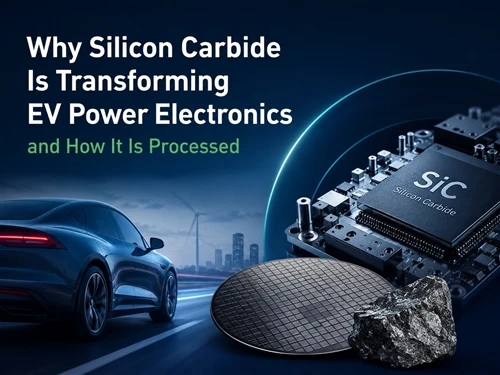
Silicon carbide (SiC) has become one of the most important engineering ceramics in modern manufacturing. Thanks to its exceptional hardness, excellent thermal conductivity, chemical stability, and outstanding electrical properties, SiC is widely used in power electronics, semiconductor equipment, electric vehicles (EVs), aerospace, and precision industrial components.
However, these same characteristics also make silicon carbide one of the most difficult materials to machine. Conventional machining often leads to rapid tool wear, edge chipping, micro-cracks, and low productivity. As manufacturers demand higher precision and better production efficiency, laser processing has become the preferred solution for machining SiC ceramics.
Today, three laser technologies are commonly considered for silicon carbide processing:
>> QCW Fiber Laser
>> 355 nm UV Nanosecond Laser
>> Picosecond Laser
Each technology offers different advantages in terms of cutting quality, processing speed, material thickness, and investment cost. Rather than asking which laser is "the best," manufacturers should determine which laser is best suited to their specific application.
This guide compares QCW fiber, UV nanosecond, and picosecond laser technologies to help you make the right decision.
Why Silicon Carbide Requires Specialized Laser Processing?
Silicon carbide combines extremely high hardness with brittle fracture behavior. Unlike metals, it has almost no plastic deformation capability. When excessive mechanical or thermal stress is introduced during machining, cracks can rapidly propagate through the material, causing edge chipping, poor surface quality, or even complete fracture.
Laser processing eliminates direct mechanical contact and enables highly localized material removal, making it particularly suitable for advanced ceramic machining.
Compared with conventional machining, laser processing offers:
>> Non-contact material removal
>> Reduced mechanical stress
>> Minimal edge chipping
>> High dimensional accuracy
>> Excellent repeatability
>> Flexible processing of complex geometries
>> Easy integration with automated production
Key Factors to Consider When Choosing a Laser
Selecting the right laser involves much more than comparing wavelengths or power levels. Before investing in a laser processing system, manufacturers should evaluate several key factors.
Material Thickness
The required cutting thickness is often the first consideration. Thick structural ceramics require high material removal rates, while thin semiconductor substrates demand precise energy control.
Edge Quality
Applications involving semiconductor packaging or electronic ceramics typically require minimal edge chipping and smooth cut surfaces.
Heat-Affected Zone (HAZ)
Reducing thermal damage helps maintain material strength and minimizes post-processing requirements.
Cutting Efficiency
High-volume manufacturing places greater emphasis on throughput and cycle time than prototype production.
Precision Requirements
Micro-holes, narrow kerfs, and intricate contours require different laser characteristics than simple profile cutting.
Total Cost of Ownership
Equipment investment, maintenance, operating costs, and production efficiency should all be considered when evaluating long-term return on investment.
QCW Fiber Laser
Best for High-Efficiency Cutting of Medium and Thick SiC Ceramics
QCW (Quasi-Continuous Wave) fiber lasers combine high peak power with high average power, making them an excellent choice for industrial processing of medium- and thick-section silicon carbide ceramics.
Advantages
>> High material removal efficiency
>> Excellent productivity
>> Stable industrial performance
>> Low maintenance requirements
>> Suitable for continuous production
>> Cost-effective operation
QCW fiber lasers are widely used for:
>> Silicon carbide structural ceramics
>> Power module substrates
>> Precision mechanical components
>> Wear-resistant ceramic parts
>> Large-format ceramic products
Limitations
Compared with shorter-wavelength lasers, QCW fiber lasers generally produce a larger heat-affected zone. For thin substrates and extremely fine features, careful parameter optimization is required to maintain excellent edge quality.
UV Nanosecond Laser
Best for Thin and High-Precision Silicon Carbide Components
Operating at a wavelength of 355 nm, UV nanosecond lasers are well suited to applications requiring fine features and excellent edge quality. The shorter wavelength enables efficient energy absorption and minimizes thermal diffusion, resulting in a smaller heat-affected zone than conventional infrared laser systems.
Advantages
>> Excellent cutting precision
>> Small heat-affected zone
>> Superior edge quality
>> Fine kerf width
>> Ideal for micro-machining
>> Excellent for thin SiC substrates
Typical applications include:
>> Semiconductor ceramic substrates
>> Electronic packaging components
>> Precision laser drilling
>> Fine contour cutting
>> Sensor ceramics
Limitations
UV nanosecond lasers generally remove material more slowly than QCW fiber lasers, making them less suitable for high-throughput cutting of thick silicon carbide ceramics.
Picosecond Laser
Best for Ultra-Precision and Research Applications
Picosecond lasers generate ultra-short laser pulses, significantly reducing thermal diffusion during material removal. This enables exceptional precision and outstanding surface quality, particularly for micro-scale features.
Advantages
>> Extremely small heat-affected zone
>> Outstanding edge quality
>> Superior dimensional accuracy
>> Minimal recast layer
>> Excellent for complex microstructures
Typical applications include:
>> Scientific research
>> Advanced semiconductor manufacturing
>> Precision medical devices
>> Microelectronics
>> Specialized optical components
Limitations
Picosecond laser systems generally involve significantly higher equipment investment and lower processing efficiency than QCW fiber or UV nanosecond systems. For many industrial silicon carbide cutting applications, the additional precision may not justify the increased cost.
Comparison: QCW Fiber vs UV Nanosecond vs Picosecond
| Evaluation Criteria | QCW Fiber | UV Nanosecond | Picosecond |
| Recommended Material Thickness | Medium to Thick | Thin | Thin |
| Cutting Speed | Excellent | Good | Moderate |
| Edge Quality | Very Good | Excellent | Excellent |
| Heat-Affected Zone | Low | Very Low | Minimal |
| Precision | Very Good | Excellent | Excellent |
| Micro Feature Capability | Good | Excellent | Excellent |
| Mass Production Capability | Excellent | Good | Limited |
| Equipment Investment | Moderate | Moderate | High |
| Operating Cost | Low | Moderate | High |
| Typical Applications | Industrial production | Precision ceramics | Ultra-precision & R&D |
Which Laser Is Right for Your Application?
Choose QCW Fiber Laser if you need:
>> High-volume manufacturing
>> Medium or thick silicon carbide ceramics
>> High cutting efficiency
>> Lower operating costs
>> Industrial production reliability
Choose UV Nanosecond Laser if you need:
>> Thin silicon carbide substrates
>> Precision contour cutting
>>Laser drilling
>> Minimal thermal impact
>> Superior edge quality
Choose Picosecond Laser if you need:
>> Ultra-high precision
>> Extremely small heat-affected zone
>> Research or prototype development
>> Complex microstructures
>> Specialized semiconductor applications
Can One Production Line Benefit from Multiple Laser Technologies?
In many manufacturing environments, different laser technologies complement rather than replace each other.
For example, QCW fiber lasers are often selected for high-efficiency cutting of structural silicon carbide ceramics, while UV nanosecond lasers handle precision trimming, drilling, and fine-feature machining. Picosecond lasers are typically reserved for specialized R&D projects or applications where ultra-high precision outweighs production efficiency.
Selecting the most appropriate laser for each manufacturing stage often delivers better overall productivity and lower production costs than relying on a single technology for every process.
Why Choose WHYC Laser?
Choosing the right laser source is only part of the solution. Machine stability, motion accuracy, process optimization, and application experience are equally important in achieving consistent machining quality.
WHYC Laser specializes in precision laser processing equipment for advanced ceramics and hard, brittle materials, including silicon carbide (SiC), aluminum nitride (AlN), silicon nitride (Si₃N₄), alumina (Al₂O₃), and zirconia (ZrO₂).
Our solutions include:
>> Silicon carbide laser cutting
>> Precision laser drilling
>> Laser scribing
>> Customized automation systems
>> Process development and optimization
>> Free sample testing and application evaluation
Whether you are processing thin semiconductor substrates or thick engineering ceramics, our engineering team can recommend the most suitable QCW or UV laser solution based on your material, tolerance requirements, and production goals.
Welcome to consult!