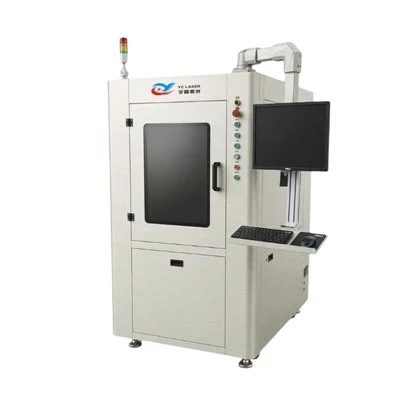
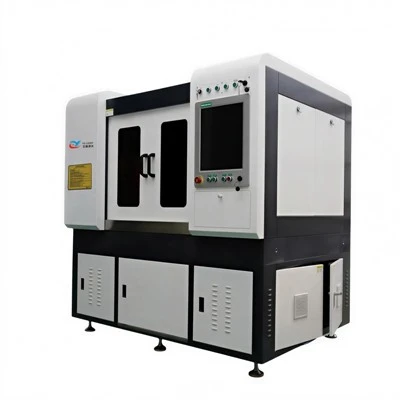
SiC Ceramic QCW Laser Cutting Machine
The SiC Ceramic QCW Laser Cutting Machine is designed for high-efficiency cutting and drilling of silicon carbide (SiC) ceramic components with typical thicknesses from 0.3 to 6 mm.
Using a QCW fiber nanosecond laser, the system provides a practical solution for SiC profile cutting, large-hole drilling, slotting, trimming, and batch blanking. It is particularly suitable for structural and functional SiC components where processing efficiency and production throughput are more important than ultra-fine edge quality.
Technical data
| Parameter | Recommended Range |
| Laser wavelength | 1060-1080nm |
| Laser output power | 150W-1000W |
| Max.cutting range | ≤300*400mm |
| Cutting thickness | 0.2-10mm |
| Material | Silicon Carbide (SiC) Ceramic |
| Laser Type | QCW Fiber Nanosecond Laser |
| Typical Thickness | 0.3–6mm |
| Main Processing | Cutting, Drilling, Slotting, Trimming |
| Large-Hole Processing | Suitable |
| Precision of repeated positioning of X/Y axis | ±5um |
| Processing speed | 0-2000mm/min |
| Maximum distance speed | 50m/min |
| Machining accuracy | ±0.01-0.02mm |
| Worktable precision | ≦0.015mm |
| Transmission mode | Imported linear motor +0.5um grating ruler |
| Whole machine power (no fan) | ≦5KW |
| Total weight of the whole machine | (about)1200KG |
| External dimension(length*width*height) | 1150*1500*1850mm |
| Micro-Hole Processing | Not the primary application |
| Typical Application | Structural & Functional SiC Components |
| Processing Mode | CNC Laser Processing |
| Customization | Available according to workpiece and process requirements |
Actual processing capability depends on SiC composition, density, geometry, thickness, required edge quality, hole diameter, and other process conditions. Sample testing is recommended before final equipment selection.
Key Processing Capabilities
0.3–6mm SiC Ceramic Cutting
The QCW laser process is optimized for silicon carbide ceramic components within the typical 0.3–6mm thickness range.
It can be used for:
● Profile and contour cutting
● External shape cutting
● Large-hole drilling
● Mounting holes
● Positioning holes
● Slotting
● Edge trimming
● Ring cutting
● Large-hole arrays
● Batch blanking
For SiC ceramics thicker than 6mm, cutting efficiency decreases and the risk of edge chipping and cracking increases. Therefore, the QCW solution is mainly recommended for SiC components within the 0.3–6mm range.
The machine is suitable for applications in semiconductor equipment, power electronics, photovoltaic furnace equipment, aerospace, industrial wear-resistant components, and other advanced ceramic industries
Why Use QCW Laser for SiC Ceramic Cutting?
High Processing Efficiency
The QCW laser provides higher average processing power than low-power UV systems, making it more suitable for thicker SiC ceramics, large contours, larger holes, and batch production.
Non-Contact Processing
Laser processing does not require direct mechanical contact between a cutting tool and the ceramic workpiece. This helps eliminate conventional tool wear and reduces mechanical loading during machining.
Flexible Profile Processing
The CNC-controlled laser path can process complex contours, slots, holes, and customized geometries without dedicated cutting dies.
This is particularly useful for small- and medium-batch SiC components and products requiring frequent design changes.
Suitable for Large-Hole Processing
Compared with low-power UV laser systems designed primarily for fine features and micro holes, QCW laser processing is better suited to larger holes and structural openings, particularly where high throughput is required.
Main Applications
1. SiC Ceramic Parts for Semiconductor Equipment
The machine can process small and medium-sized SiC ceramic components used inside semiconductor manufacturing equipment.
Typical components include:
● Small ceramic boats
● Wafer carriers
● Chamber liner components
● Insulating bases
● Ceramic fixtures
● Fixture pads
● Structural ceramic components
2. SiC Insulation and Heat-Dissipation Components for Power Electronics
SiC ceramic plates and components are increasingly used in power electronics and high-temperature electrical applications.
Typical applications include:
● IGBT-related ceramic components
● Power module insulation plates
● Heat-dissipation substrates
● Inverter insulation plates
● Ceramic mounting plates
● Power electronics structural components
● Typical thicknesses are approximately 0.8–4mm.
3. SiC Carrier Plates and Thermal Components for Photovoltaic Furnaces
SiC ceramics are widely used in high-temperature furnace environments because of their thermal and chemical stability.
Typical components include:
● SiC carrier plates
● Small SiC loading plates
● Thermal insulation plates
● Ceramic spacer plates
● Ceramic boat sections
● Furnace structural components
4.SiC Components for Aerospace Applications
The system can also be used for selected small- and medium-sized C/SiC and SiC structural components.
Potential processing applications include:
● Thermal protection components
● Structural ceramic parts
● Sealing component blanks
● Edge trimming
● Cooling holes
● Large openings
● Slots
5. Industrial Wear-Resistant SiC Components
SiC ceramics are also used in demanding industrial environments where wear resistance, chemical resistance, and high-temperature stability are required.
Typical components include:
● SiC sealing rings
● Wear-resistant liners
● Ceramic bushings
● Wear-resistant plates
● SiC filter plates
● Flow-control components
QCW Laser vs. UV Laser for SiC
Different SiC applications require different laser processing strategies.
| Processing Requirement | QCW Fiber Laser | UV Laser |
| Typical SiC thickness | 0.3–6mm | 0.1–2mm |
| Thick ceramic cutting | ★★★★★ | ★★ |
| Thin SiC cutting | ★★★ | ★★★★★ |
| Large contour cutting | ★★★★★ | ★★★ |
| Large-hole processing | ★★★★★ | ★★ |
| Micro-hole processing | Not the main application | ★★★★★ |
| Batch blanking | ★★★★★ | ★★★ |
| Fine features | ★★★ | ★★★★★ |
| Ultra-low edge damage | ★★–★★★ | ★★★★–★★★★★ |
| Processing efficiency on thicker SiC | High | Low |
Customized SiC Laser Processing Solutions
SiC ceramics vary significantly in composition, density, thickness, geometry, and processing requirements. Therefore, laser parameters should be developed according to the actual workpiece rather than relying only on nominal laser power.
WHYCLASER provides sample testing and process evaluation for SiC ceramic applications.
Hope you can provide:SiC material information, Workpiece drawings, CAD files, Material thickness, Hole diameter ,Cutting dimensions, Required edge quality, Expected production volume
Send us your SiC sample, drawing, thickness, and processing requirements for a customized laser processing evaluation.
Our engineering team can evaluate the application and recommend a suitable laser source, power configuration, optical system, motion platform, and processing strategy.
| Related Pages |
| Ceramic Laser Cutting Machine |
| Ultrafast Laser Micromachining Equipment |
| Silicon Carbide (SiC) Ceramic Laser Cutting Machine |
| Laser Processing Video |
| Laser Processing Service |
| Request A Quote |
FAQ
Can the QCW laser drill micro holes in SiC?
QCW is primarily intended for larger holes and structural openings rather than precision micro holes. For very small holes, such as approximately 0.05–0.2mm, a UV laser solution is generally more suitable.
How do I choose between QCW and UV laser for SiC?
For thicker SiC, large contours, large holes, and high-throughput production, QCW is generally the better choice. For thin SiC, micro holes, fine structures, and lower thermal impact, UV laser processing is more suitable.
Can you test our SiC samples before equipment purchase?
Yes. Sample testing is recommended because SiC processing results depend on material composition, thickness, geometry, and quality requirements. Customers can provide samples or drawings for process evaluation and equipment configuration.
Hot Tags: sic ceramic qcw laser cutting machine, China sic ceramic qcw laser cutting machine manufacturers, suppliers, factory