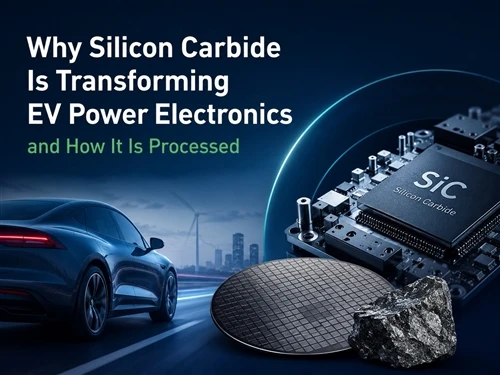
Silicon carbide (SiC) is one of the most challenging engineering ceramics to machine. Its exceptional hardness, high brittleness, excellent thermal conductivity, and outstanding wear resistance make it an ideal material for power electronics, semiconductor equipment, aerospace, EV components, and precision industrial applications.
However, these same properties also make silicon carbide highly susceptible to edge chipping, micro-cracks, and thermal damage during machining. Traditional diamond tools often generate significant mechanical stress, leading to poor edge quality, reduced component strength, and increased scrap rates.
As a result, laser cutting has become the preferred solution for precision silicon carbide machining. By eliminating direct mechanical contact and precisely controlling energy input, laser processing can significantly reduce chipping while improving dimensional accuracy and production efficiency.
In this guide, we'll explain why silicon carbide chips during cutting and share practical methods for achieving clean, crack-free laser processing.
Why Does Silicon Carbide Chip During Cutting?
Unlike metals, silicon carbide has almost no plastic deformation capability. Once the local stress exceeds its fracture toughness, microscopic cracks rapidly propagate through the material, resulting in edge chipping or even complete fracture.
Several factors contribute to this problem:
>> Excessive mechanical cutting force
>> Heat accumulation during machining
>> Improper laser parameters
>> Poor beam focus control
>> Inadequate assist gas
>> Unstable machine motion
>> Material defects or residual stress
Among these factors, mechanical stress and uncontrolled thermal stress are the two primary causes of edge chipping.
Why Laser Cutting Reduces Chipping
Laser cutting is a non-contact machining process, eliminating the cutting forces associated with conventional tools.
Compared with mechanical machining, laser processing offers several advantages:
>> No tool wear
>> No cutting force
>> Reduced edge chipping
>> Minimal micro-cracks
>> Higher dimensional accuracy
>> Better consistency for automated production
>> Suitable for complex geometries and micro features
When process parameters are properly optimized, laser cutting can produce clean, smooth edges with minimal post-processing.
Key Factors for Chip-Free Silicon Carbide Laser Cutting
Achieving high-quality silicon carbide laser cutting depends on much more than selecting the right laser source. Process optimization plays an equally important role.
1. Choose the Right Laser Technology
Different laser sources are suitable for different applications.
QCW Fiber Laser
QCW (Quasi-Continuous Wave) fiber lasers provide high peak power with excellent material removal efficiency, making them ideal for medium- and thick-section silicon carbide ceramics.
Typical advantages include:
>> High cutting efficiency
>> Stable performance
>> Excellent productivity
>> Suitable for large-scale manufacturing
>> Capable of processing thick SiC ceramic components
QCW lasers are widely used for structural ceramics, wear-resistant parts, semiconductor fixtures, and power electronics.
UV Nanosecond Laser
UV nanosecond lasers operate at a wavelength of 355 nm, allowing materials to absorb laser energy more efficiently while minimizing thermal diffusion.
Their advantages include:
>> Extremely small heat-affected zone
>> Excellent edge quality
>> High precision
>> Ideal for thin SiC substrates
>> Suitable for micro-features and precision components
UV lasers are commonly used for semiconductor ceramics, electronic substrates, precision drilling, and fine contour cutting.
2. Optimize Laser Parameters
Even with the correct laser source, poor process parameters can still cause edge defects.
Critical parameters include:
>> Pulse width
>> Peak power
>> Repetition frequency
>> Scanning speed
>> Pulse overlap
>> Multi-pass cutting strategy
Rather than removing all material in a single pass, gradual layer-by-layer ablation helps reduce thermal stress and improves edge quality.
3. Maintain Accurate Focus Position
Laser focus directly affects energy density.
An incorrect focal position may cause:
>> Wider kerf
>> Poor verticality
>> Rough surfaces
>> Increased heat accumulation
>> Edge chipping
High-precision motion systems combined with automatic focus control significantly improve cutting consistency.
4. Use Proper Assist Gas
Assist gas removes molten material while reducing oxidation and heat accumulation.
Depending on the application, commonly used gases include:
>> Compressed air
>> Nitrogen
>> Oxygen (for specific applications)
Stable gas pressure also helps produce cleaner kerf walls and better edge quality.
5. Improve Machine Stability
Even perfectly optimized process parameters cannot compensate for poor machine accuracy.
High-quality laser cutting equipment should provide:
>> High-precision linear motor motion
>> Stable granite or marble machine base
>> High-resolution vision positioning
>> Closed-loop motion control
>> Excellent vibration resistance
Machine rigidity is particularly important when processing brittle engineering ceramics.
Best Practices for Crack-Free Silicon Carbide Laser Cutting
Manufacturers can significantly reduce edge chipping by following these recommendations:
>>Use non-contact laser machining instead of mechanical cutting.
>> Select the laser source according to material thickness and precision requirements.
>> Optimize pulse width, peak power, and scanning speed.
>> Adopt multi-pass processing for thicker components.
>> Maintain accurate beam focus throughout the cutting process.
>> Use stable assist gas flow and efficient debris removal.
>> Choose high-precision motion systems for consistent machining quality.
In many cases, edge quality is determined not by a single factor, but by the combination of equipment performance, process optimization, and application experience.
Common Applications of Silicon Carbide Laser Cutting
Chip-free laser cutting is widely used in:
>> Silicon carbide ceramic substrates
>> Semiconductor components
>> Power module ceramics
>> Aerospace structural parts
>> Precision wear-resistant components
>> High-temperature mechanical parts
>> Thermal management components
As demand for silicon carbide continues to grow, laser processing has become an essential manufacturing technology across multiple high-end industries.
Why Work with YCLaser?
Selecting the right laser technology is only part of the solution. Stable equipment performance, optimized process parameters, and application expertise are equally important for achieving consistent, chip-free results.
WHYC Laser specializes in precision laser processing solutions for advanced ceramics and hard, brittle materials, including silicon carbide (SiC), aluminum nitride (AlN), silicon nitride (Si₃N₄), alumina (Al₂O₃), and zirconia (ZrO₂).
Our systems support:
>> Precision laser cutting
>> Micro-hole laser drilling
>> Laser scribing
>> Custom process development
>> Sample testing
>> Automated production solutions
Whether you're developing a new SiC component or scaling up mass production, our engineering team can recommend the most suitable laser solution based on your material, thickness, precision requirements, and production goals. Contact us now